Tuesday, April 13, 2010

IEA: OPEC had first big drop in output in a year

PARIS (AP) -- Recovery in the world's biggest economies could be jeopardized if crude oil prices stay over $80 per barrel, the International Energy Agency said Tuesday.

The IEA also reported that OPEC posted the first "significant decline" in output in March in more than a year -- falling 190,000 barrels per day to 29 million barrels a day -- largely due to a near 10-percent drop in Iraqi output.

The agency, the energy arm of the Organization for Economic Cooperation and Development, a grouping of the world's richest nations, said concerns remain that global oil markets are "overheated," with crude around $85 per barrel.

"Ultimately, things might turn messy for producers if $80-100 (per barrel) is merely seen as the new $60-80 (per barrel), stunting economic recovery while prompting resurgent non-oil and non-OPEC supply investment" the Paris-based IEA said in its monthly oil market report.

Price subsidies that benefit consumers in non-OECD countries like China and India, and tighter credit than two years ago "could stall OECD economic recovery or render it more oil-less than we currently envisage," it said.

The IEA said that operational problems and weather-related export disruptions at its southern terminals drove down Iraqi output by 220,000 barrels per day last month. But the agency noted that Iraq's exports hit a two-decade high of 2.07 million barrels a day in February, and total exports in March were tallied at 1.79 million.

The IEA estimated global demand in 2010 would rise by 30,000 barrels a day in 2010 to 86.6 million barrels a day compared to last month's report. Demand for 2009 was revised down by 70,000 barrels to 84.9 million.

The agency said OPEC kept its output targets unchanged last month largely on expectations that global oil demand will pick up later this year to absorb above-target production.

Oil prices have been hovering around 18-month highs of $80-85 per barrel. The international oil cartel is not expected to meet again until Oct. 14 in Vienna.

Qatar's oil minister said last week that crude's recent rally is driven mainly by speculation, not a shortage of supply, and dismissed the likelihood that OPEC would hold a special meeting to re-evaluate current production.

Monday, April 12, 2010

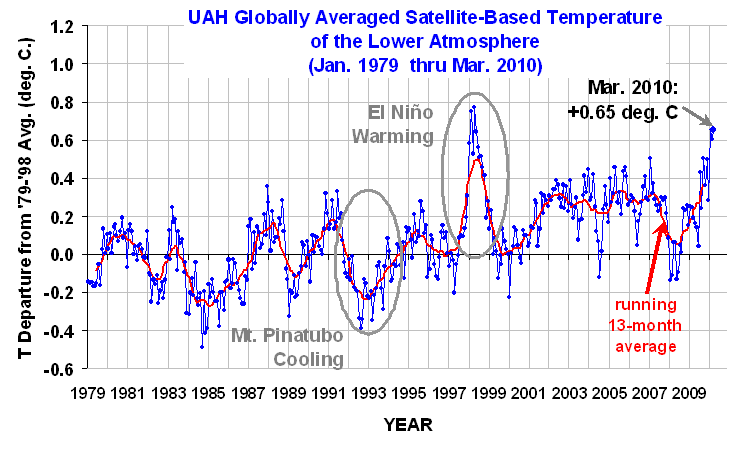
Temperatuur tõuseb - Bye-bye, global cooling myth: Hottest March and hottest Jan-Feb-March on record”

UAH Spencer March 10

It was the hottest March in both satellite records (UAH and RSS), and tied for the hottest March on record in the NASA dataset. It was the hottest (or tied for hottest) January through March in all three records.

The record temperatures we’re seeing now are especially impressive because we’ve been in “the deepest solar minimum in nearly a century.” It now appears to be over. It’s just hard to stop the march of anthropogenic global warming, well, other than by reducing greenhouse gas emissions, that is.

NASA’s prediction from last month is standing up: “It is nearly certain that a new record 12-month global temperature will be set in 2010.″ Actually, NASA made that prediction back in January 2009:

Given our expectation of the next El Niño beginning in 2009 or 2010, it still seems likely that a new global temperature record will be set within the next 1-2 years, despite the moderate negative effect of the reduced solar irradiance.”

Of course, there never was any global cooling — see Must-read AP story: Statisticians reject global cooling; Caldeira — “To talk about global cooling at the end of the hottest decade the planet has experienced in many thousands of years is ridiculous.” Indeed, the overwhelming majority of the warming went right where scientists had predicted — into the oceans (see “How we know global warming is happening”):

Figure: “Total Earth Heat Content [anomaly] from 1950 (Murphy et al. 2009). Ocean data taken from Domingues et al 2008.”

NASA’s draft paper reported: “We conclude that global temperature continued to rise rapidly in the past decade” and “that there has been no reduction in the global warming trend of 0.15-0.20°C/decade that began in the late 1970s.”

NOAA points out that both satellite data sets show about the same amount of warming as the land-based record, “which increased at a rate near 0.16°C/decade (0.29°F/decade) during the same 30-year period” — once you remove the expected stratospheric cooling from the satellite records (see NOAA discussion here).

Wednesday, April 7, 2010

HOW MUCH OIL IS LEFT?

American journalist and writer Richard Heinberg is one of the world's foremost Peak Oil educators. He has taught at New College of California’s Campus for Sustainable living a program on "Culture, Ecology and Sustainable Community" until March 2008 and is a Senior Fellow in Residence of the Post Carbon Institute in Santa Rosa, California. He is the award-winning author of nine books including:

  • The Party's Over: Oil, War and the Fate of Industrial Societies (2003),
  • Powerdown: Options and Actions for a Post-Carbon World (2004),
  • The Oil Depletion Protocol: A Plan to Avert Oil Wars, Terrorism and Economic Collapse (2006),
  • Peak Everything: Waking Up to the Century of Declines in Earth’s Resources (2007).

His monthly MuseLetter has been published since 1992 and his essays and articles have appeared widely in such journals as The American Prospect, Public Policy Research, Quarterly Review, Z Magazine, Yes!, Resurgence, The Futurist and European Business Review. Moreover, he was featured prominently in documentary films such as “The End of Suburbia” (2004) by Gregory Greene and Barrie Silverthorne (see for more information: www.endofsuburbia.com). With a wry, unflinching approach based on facts and realism, Mr. Heinberg exposes the tenuousness of our current way of life and offers a vision for a truly sustainable future. Since 2002, he has given over three hundred lectures on the subject matter of Peak Oil to a wide variety of audiences. He and his wife Janet Barocco live in Santa Rosa, California.

Mr. Heinberg, your most successful book-title to this date is ”The Party’s Over.“ For those of our readers who have never heard of you and that book: What kind of party is it that you were writing about and why do you assume that this festivity and its special features are about to come to an end?

The “party” was humanity’s one-time-only opportunity to fuel economic growth and technological innovation with a bounty of cheap, abundant energy from fossil fuels. The harvesting of oil, coal, and natural gas has inevitably proceeded on a best-first or low-hanging fruit basis. While the Earth still possesses a wealth of unexploited energy resources, the cheapest and easiest-accessed of those resources have by now already been used. All of these fuels are in the process of becoming more expensive, and the various energy alternatives are limited in one way or another in their ability to replace hydrocarbons. That means we are currently seeing the end of economic growth as we have known it. The impacts for transportation, globalization, and world food supplies will be serious indeed.

As a rather critical observer of that party: Do you see significant hints that a growing number of participants realize that “The Last Waltz” is near? Or are you afraid that large parts will continue to dance no matter what?

After over a decade spent in trying to alert policy makers and the general public about this issue, I have concluded that only a small minority have any idea what is in store. The “dance” you speak of is indeed coming to an end, but it appears to most that the problem is purely a financial one, and that once the global economic crisis is sorted out, we will all be able to get back to business as usual. I do not believe that is an option. We have reached a fundamental turning point, foreseen in the “Limits to Growth” study of 1972. For a while, world leaders may be able to redistribute wealth in various ways—most likely from the poor to the rich—in order to make it appear that the global economy is continuing to grow. But I suspect that this will work only for a very few years at most. At some point soon, it will become clear that economies are contracting. And then most people will look for someone to blame. No doubt politicians will oblige by trotting out various scapegoats.

What about the hosts of the party, who pay the band – the so-called elites? They’re aware of the coming situation for a long time, right? What kind of plans do they have in store for themselves and the rest of us in your opinion? As part of the elites, the Central Intelligence Agency for example, which has always entertained close ties to the financial district in New York City,[1] had the Peak Oil problem on its radar screen at least since the late 1970’s.[2] Hence, we can be sure that some influential interests not only knew that this historical watershed event was coming, but also that they had enough time to prepare for it.

Strangely enough, I think most of the “elites” are victims of their own public relations efforts. They have promoted the careers of economists who told them what they wanted to hear—that economic growth is the normal and inevitable state of affairs, and that there are no real limits to growth. Yes, certainly there are analysts in the CIA and the military who understand where this is all heading, but—if the ex-analysts I’ve talked to are typical of their colleagues—they have learned that reports about resource constraints are not welcome, unless they are framed in terms of the contest for geopolitical leverage

At the end of last year, the World Energy Outlook 2009 received a very cautious reception – for example from your side.[3] Why was that and how was it linked to the ongoing discussion about oil reserves? May I also ask you to explain to our readers why the picture related to the latter seems very blur and since when?

Oil “reserves” consist of estimates of the amount of oil that geologists believe can be economically extracted from oilfields that have been discovered, drilled, and mapped. Unfortunately, reserves reporting is not a transparent affair in many countries that have state-controlled oil industries. There is strong evidence to suggest that OPEC nations have systematically and substantially over-estimated their reserves for over two decades.

In 2009, the International Energy Agency (IEA) took a first cautious step in the direction of realism when it published, in its annual World Energy Outlook, an assessment of rates of production decline from the world’s old, giant oilfields, which yield the bulk of the world’s crude oil. On average, there is a net production decline of 4.5 percent per year from existing fields, which means that the world has to develop a Saudi Arabia’s worth of new production capacity every five years or so just to maintain existing total production volumes. That is an enormous feat, especially given the fact that oil discovery rates have been falling since the early 1960s. New oilfields are sill being found, of course, but typically they are very expensive to locate and exploit, when compared to the oilfields that were being discovered only a decade or two ago.

This debate, that we’ve just mentioned, is continuing right now again on a large scale.[4] Maybe there is, if one wants to, an end to it. During an interview with investigative journalist and book author Mike Ruppert, I’ve asked him a few things about the National Energy Policy Development Group, NEPDG, that was run by then-Vice President Richard Cheney in Spring of 2001. Mr. Ruppert stated:

“Essentially the NEPDG appears to have been set up, almost from the first day of the Bush administration, to find out how much oil was left, who had it, and how it could be obtained (bought or stolen) to support U.S. hegemony, U.S. consumption, and the monetary paradigm. … The fact that the NEPDG records have been kept secret from the American people who paid for it is one of the greatest crimes of all time. Seeing those records now would save a lot of duplicated effort in trying to inventory how much oil there is left. The figures on oil reserves quoted by producing nations and companies are as fraudulent and cooked as the books on mortgages, banking, and even Bernie Madoff. … It was Peak Oil that was driving Dick Cheney's Task Force and nothing else.”[5]

Do you agree with Mr. Ruppert in general and in particular on the notion that the secret NEPDG-records could help us to find out “how much oil there is left”?

Since we don’t know what those records contain, we also don’t know if they would help us to know much more about future energy supply options. Certainly if an agency like the IEA were empowered to perform on-the-ground audits of oilfields in all oil exporting countries, we would know much more than we do now.

In another interview, I’ve asked economist James K. Galbraith, who thinks that the Peak Oil scenario “needs to be taken seriously,” if he agrees that it would be time to make those secret files of the NEPDG public. He answered by saying:

“Yes. I do agree that files of this type should be made public. If there is an argument, which undoubtedly some people will make, for a national security reason not to make them public, then an appropriate procedure, which we have followed in this country in the past, is to appoint a panel of independent outsiders, not previously connected to the government, to review the documents and to make them public unless there is a compelling reason not to, with arguments about what is compelling and not-compelling ultimately resolved by the president himself. That’s a model that has been applied successfully in the past in the United States on a matter of this kind. I think it would be very useful to do it in this and other instances on the conduct of the Bush administration.”[6]

My question for you is: Wouldn’t it be a good goal for the Peak Oil movement in the U.S. and around the globe to come together for a concerted effort to make happen what Mr. Galbraith was talking about? Even if there was only a slim chance to accomplish this goal?

Yes, this would be a worthy goal from a certain standpoint. However, the peak oil “movement” is a highly non-political collection of individuals with little sense of group identity or any history of concerted political action. Even if the effort succeeded, I doubt if much truly new information would be revealed. Many “peak oil” analysts are already extremely well informed on world energy supply issues—much better informed than all but a very few officials at even the highest levels of government, and better informed than most of the members of the National Energy Policy Development Group. So the advantage would not be in finding out some information that is currently being kept secret, it would simply be in seeing public confirmation of certain key bits of information that are seldom discussed in the mainstream media.

Mr. Heinberg, you have stated publicly in 2004 that you have your doubts related to the official narration of the attacks of 9/11.[7] May I ask you if those attacks are in your opinion connected to Peak Oil?

I have no idea. My assertion then and now is simply that the events of 9/11 were not properly investigated. It is certainly tantalizing to imagine what a proper investigation would uncover, but imagine we must—because at this point the likelihood of a re-opening of that case is extremely remote. It is a dead issue.

One facet of the “Global War on Terror” that resulted from those attacks, is the U.S. invasion of Iraq. What has this invasion to do with oil, or more specifically: with the competitive relationship between the US-dollar vs the Euro? Was there a threat looming for the so-called “Petrodollar System” that was established during the early 1970’s?

There was some speculation at the time of the invasion that part of the motive was to protect the U.S. dollar, which is the currency used in nearly all international oil sales. Saddam Hussein had been threatening to abandon the use of the dollar, and some saw this as a mortal threat to global dollar hegemony. In retrospect, I’m not sure that analysis holds up, though I agreed with it at the time. While the level of U.S. debt is such that one might expect other nations to be looking for some alternative to the dollar for international transactions, the reality is that there is no good candidate at the moment.

I suspect that there were complex motives for the invasion of Iraq. It is strange that even today, seven years later, we must speculate on this question. The public still has not been told the real reasons for one of the longest and most expensive wars in recent history.

What would happen to the US economy if the “Petrodollar System” would collapse? Do you see signs that this arrangement to the advantage of US-American consumerism could come to an end rather sooner than later?

At some point the dollar will indeed fail as a currency. Whether this failure comes about as a result of oil exporters dumping the dollar, or simply because of problems inherent to the U.S. economy remains to be seen. And it is impossible to know whether that moment is a few months or many years ahead of us. I suspect that we will see some serious problems with the dollar well before 2020. Certainly every effort will be made to keep the current world monetary system working as long as possible, but the problems just keep accumulating. The result may be a rather sudden re-adjustment in which enormous amounts of apparent wealth simply disappear, and global trade comes to a nearly complete halt, at least temporarily.

In the past, you have said that the worst thing that could happen is a financial / economic crisis at the exact same time when we’re about to enter the Peak Oil phase. Well, obviously this seems to be the case now. Why has this been a nightmarish outlook for you? And do you think that this financial / economic crisis, which remains mysterious and enigmatic to most people, will usher in on a global scale what Robert Kennedy once called “the mindless menace of violence”? If you agree on that, isn’t that the result not of this crisis alone, but also because people are not told the truth about its long-lasting character in an honest way?

The reason it’s bad for both an energy crisis and a financial crisis to occur together is that each makes the other harder to address. Without adequate credit and investment capital, how will we build renewable energy infrastructure to replace our current fossil-fuel-dependent transport and electricity systems? And without cheap energy, how can we dig ourselves out of a financial crisis?

As you point out, both are indeed happening now, and this should be no surprise given the inherent linkages between energy prices and the health of the economy. Will we see global violence as a result? Of course I hope the answer is “no,” but the likelihood of war would be substantially reduced if the general public had a better idea of why their standard of living is eroding. Since politicians don’t really understand what is happening, I suppose they can be somewhat excused for not telling their constituents. But that means, once again, that the most likely response will be a hunt for scapegoats.

Now that we’ve already touched the subject “money”: What has the financial crisis and the ongoing recession to do with the monetary system and debt-based growth? Is there a tricky part involved - just as Mike Ruppert characterized it this way during the above mentioned interview:

a) The current global economic paradigm -- governed by fractional reserve banking, fiat currency, and compound interest (debt-based growth) -- is inherently and by definition a pyramid scheme. Money is useless without energy. One cannot eat a dollar bill or crumble it up and throw it in his gas tank. Each of the trillions of dollars created out of thin air since the fall of 2008 is a commitment to expend energy that cannot and will not ever be there.

b) There can be no "recovery", no return to growth (which is what the economic paradigm demands), without energy.[8]

Yes, I agree with Mike Ruppert on this. If the world is to return to stability, an entirely new economic system, based on a new and different form of money, will be required. The world still has willing workers and consumers, and enormous productive capacity in the forms of factories, soils, and recyclable materials. But without a functioning monetary system, there will be no means of connecting production with consumption. Our current money system requires constant growth so as to enable repayment of the interest on the debts that created the money to begin with, so it cannot function well in the context of general resource scarcity and economic contraction.

How does a new monetary system need to look like vis-à-vis Peak Oil?

There are many possibilities for alternatives, including tradable energy vouchers.

Is it this monetary change that has to take place that constitutes the “Heart of Darkness” so to speak when it comes to the problem that the elites and the mainstream media are “too fearful to publicise peak oil reality”?[9]

I don’t think reality is that conspiratorial. Certainly there are some deep, dark conspiracies out there, but with regard to peak oil my belief is that, for the most part, the elites genuinely do not understand the situation or its implications.

Of interest with regard to the recession is of course the oil price spike of 2008. Global Portfolio Strategist Marshall Auerback stated in an interview with me that even though “recessionary pressures were already ‘baked in the cake’ well before the oil price spike”, that this was “the straw that broke the camel's back, or the ‘icing on the cake.’”[10] That given, I would like to get your reading of that oil price spike. Do you agree with James Hamilton’s analysis given in “Causes and Consequences of the Oil Shock of 2007-08”?[11]

Yes, I discussed Hamilton’s analysis at some length in my essay “Temporary Recession or the End of Growth?” http://heinberg.wordpress.com/ There’s no point trying to paraphrase that article here; if readers are interested, they can read it. I think it’s a pretty good summary of the situation.

Critique on the Peak Oil scenario comes from all kinds of sides. Among them are the advocates of the abiogenic petroleum origins. What is your response to those critiques – for example related to the doubts that the common theory of fossil fuels was never scientifically proven?

I have also published an essay on this subject, titled “The Abiotic Oil Controversy” http://energybulletin.net/node/2423. To summarize: there may indeed be some interesting points for further research regarding the origins of some of Earth’s hydrocarbons. But that research is unlikely to have immediate practical implications for the supply of oil or natural gas. These fuels are found only in sedimentary basins, and those basins have already been identified by geologists using every tool from pick and compass to seismic surveys to satellite imaging. Moreover, oil and gas wells are observed to deplete, and are not observed to replenish themselves in an economically significant way over humanly observable time scales. The very few exceptions to these general statements have been studied by geologists and explained in terms of local anomalies.

Another thing one can hear quite often is that Peak Oil authors / educators like you are spokesmen for big oil interests. Does this make sense to you? Why should the oil and automobile industry be interested in propagating a “Peak Oil myth”?

If I’m secretly on the payroll of an oil company, then somebody forgot to let me in on the secret. A few of the oil companies are delicately admitting some of the main elements of the peak oil thesis. Other oil companies heatedly deny any possibility of supply problems and call people like me very nasty names. Some of the auto companies, such as Toyota, understand peak oil and speak of it openly. But I don’t see any public relations advantage whatsoever in some supposed cynical plot to promulgate a “peak oil myth.” I’ve been studying this subject for over a decade and have interviewed dozens of people inside and outside of these industries, including scientists, managers, economists, and public relations officers, and have seen no evidence whatsoever of such a plot. Instead I see general ignorance and denial. Those within the industry who do understand peak oil tend to be scientists, though there are exceptions. Scientists often do rather poorly at following instructions with regard to fabricating myths. They have an annoying habit of seeking out data, analyzing it, and thinking for themselves.

Mr. Heinberg, we seem to face huge problems with Climate Change, Overpopulation and the depletion of natural resources in general, not only hydro carbons. Climate Change is discussed worldwide – so let the both of us concentrate on the other two points. Where the whole problem of Peak Oil is getting real ugly is the whole issue of Overpopulation. Without oil there would never have been the possibility to let the world population rise to 6.5 billion human beings. Therefore, the outlook of Peak Oil is that now that we have all those humans on Planet Earth, the oil that supports them declines. Two questions: how do you cope with the knowledge you have about that day in, day out? And don’t you fear that mankind is about to lose the last rest of dignity that was leftover after the barbaric events of the 20th Century?

How do I cope with the knowledge? Well, it’s distressing, but one learns to cope. As we age, we are forced to cope with the knowledge of our own mortality. Our relatives and friends start dying. It’s depressing, but we go on. What would be really depressing would be to have knowledge about imminent global crises but to have no way of influencing the situation. In fact, there is a great deal that still can be done to lessen impacts on humanity and the natural world, and as we engage in that kind of activity it tends to help us psychologically.

Another major problem that we face is the depletion of natural resources in general – you sum it up best by giving your book on this subject the title: “Peak Everything.”[12] In that book you mention that

“in the course of the present century we will see an end to growth and a commencement of decline in all of these parameters:

- Population,

- Grain production (total and per capita),

- Uranium production,

- Climate stability,

- Fresh water availability per capita,

- Arable land in agricultural production,

- Wild fish harvests,

- Yearly extraction of some metals and minerals (including copper, platinum, silver, gold and zinc).”[13]

Can you tell us how we humans can survive this especially seen under the focus of Liebig’s Law (or the Law of the Minimum)?

As I say in the book, we must reduce the scale of the human project—our population and our consumption rates (the latter especially in the industrialized nations). That means redesigning our economic and food systems, re-localizing and down-sizing them, until they can be maintained with renewable resources harvested at sustainable rates.

Do you fear that some people in powerful positions become increasingly “trigger happy” – that is to say, that they will try to get us involved in a major war as a Last Exit Strategy?

I don’t see major war as an “exit strategy”; if it happens, it will likely be simply a failure of politics—an expression of the inability of leaders to solve the worsening problems that are confronting them.

To sum our interview up, Mr. Heinberg: We’re about to enter extremely interesting, stormy times. They have a lot of danger in store for us. On the other hand, isn’t it true that the coming 20 – 30 years will be a great opportunity to totally re-evaluate who we are and what is really important to us?

Absolutely. Every crisis is an opportunity, and we will be presented with the greatest array of opportunities in history. Survival will require us to evolve quickly, and to change our thinking, our habits, and our expectations. If we do these things, it is just possible that the society that emerges in the process will be far more stable, interesting, and beautiful than the one we see around us today.

Thank you very much for taking your time, Mr. Heinberg!

My pleasure, thank you!

SOURCES:


[1] compare Michael C. Ruppert: “Crossing the Rubicon. The Decline of the American Empire at the End of the Age of Oil”, New Society Publishers, Gabriola Island, 2004, page 53 – 57, and Peter Dale Scott: “The Road to 9/11. Wealth, Empire, and the Future of America”, University of California Press, Berkeley, 2007, page 11 – 14.

[2] compare Richard Heinberg: “Smoking Gun: The CIA's Interest in Peak Oil“, published at From the Wilderness on August 15, 2003 under:

www.fromthewilderness.com/free/ww3/081503_cia_russ_oil.html

[3] see Richard Heinberg: “Just Tell Us The Truth”, published November 10, 2009 under:

www.postcarbon.org/blog-post/44016-just-tell-us-the-truth

and Lars Schall: “Hat die Welt Peak Oil erreicht?”, published at MMNews on November 12, 2009 under:

http://www.mmnews.de/index.php/200911124199/MM-News/Hat-die-Welt-Peak-Oil-erreicht.html

[4] compare Rowena Mason: “Oil reserves 'exaggerated by one third'”, published at The Telegraph on March 22, 2010 under:

http://www.telegraph.co.uk

and Vincent Fernando: “U.S. Government Exposes Its Own Oil Supply And Demand Data To Be Completely Flawed”, published at Business Insider on March 22, 2010 under:

http://www.businessinsider.com

[5] Lars Schall: “The Sinking Titanic”, Interview with Michael C. Ruppert, published at Energy Bulletin on May 22, 2009 under: www.energybulletin.net/node/48990

[6] Lars Schall: ”There Is No Return To Self-Sustaining Growth“, Interview with James K. Galbraith, published at New Deal 2.0 on February 2, 2010 under:

http://www.newdeal20.org

[7] compare Richard Heinberg: “Powerdown. Options and Actions for a Post-Carbon World “, New Society Publishers, Gabriola Island, 2004, page 70 – 71.

[8] see footnote 5.

[9] see Madeleine Bunting: “Too fearful to publicise peak oil reality”, published at The Guardian on November 10, 2009 under: http://www.guardian.co.uk

[10] Lars Schall: “Many Years Of Economic Stagnation”, Interview with Marshall Auerback, published at Energy Bulletin on September 9, 2009 under: www.energybulletin.net/node/50067

[11] James D. Hamilton: “Causes and Consequences of the Oil Shock of 2007-08.” ABSTRACT: “This paper explores similarities and differences between the run-up of oil prices in 2007- 08 and earlier oil price shocks, looking at what caused the price increase and what effects it had on the economy. Whereas historical oil price shocks were primarily caused by physical disruptions of supply, the price run-up of 2007-08 was caused by strong demand confronting stagnating world production. Although the causes were different, the consequences for the economy appear to have been very similar to those observed in earlier episodes, with significant effects on overall consumption spending and purchases of domestic automobiles in particular. In the absence of those declines, it is unlikely that we would have characterized the period 2007:Q4 to 2008:Q3 as one of economic recession for the U.S. The experience of 2007-08 should thus be added to the list of recessions to which oil prices appear to have made a material contribution.” James D. Hamilton : “Causes and Consequences of the Oil Shock of 2007-08“, Department of Economics, UC San Diego, published February 3, 2009, Revised: April 27, 2009, at:

http://www.brooking.edu/

[12] Richard Heinberg: “Peak Everything. Waking Up to the Century of Decline in Earth’s Resources“, Clairview Books, Forest Row, 2007.

[13] Ibid., page 4.

Thursday, April 1, 2010

Obama Administration Cops to Likelihood of Looming Global Oil Shortage: PCI Requests Transparency of Energy Policy

Tod Brilliant
POST CARBON INSTITUTE
tod@postcarbon.org
707-823-8700 x105

Obama Administration Cops to Likelihood of Looming Global Oil Shortage: Post Carbon Institute Requests Transparency of Energy Policy

In an exclusive interview published March 25 in Le Monde, Glen Sweetnam, the Obama administration’s official expert on the oil market, confirmed nearly every element of the “Peak Oil” scenario that many analysts both in and outside the oil industry have warned of for years:

• A decline of world oil production could begin soon—perhaps next year, and
• Only extraordinary levels of investment by the oil industry can maintain current rates of production much longer.

After decades of ignoring the “Peak Oil” theory that predicts global oil production will peak and then rapidly decline, Sweetnam’s admission marks a profound shift in the U.S. government’s position on energy depletion.

"I understand how difficult it must be for officials of the Department of Energy to acknowledge that the lifeblood of the industrial economy--cheap oil--is disappearing faster than they had previously forecast,” says Richard Heinberg, Senior Fellow at Post Carbon Institute. “But the American People deserve the truth."

Semantics Won’t Save Us
While Sweetnam and the Obama Administration prefer to use the term “undulating plateau” to “peak,” the terms are nearly identical. Lauren Mayne, responsible for liquid fuel prospects at the Department of Energy notes: “Once maximum world oil production is reached, that level will be approximately maintained for several years thereafter, creating an undulating plateau. After this plateau period, production will experience a decline.”

“Approximately.” “Several years.” In other words, the Obama Administration is predicting declining oil flow rates in the near future. Also known as peak oil. With 2005 now standing as the record year for total world crude production, we are already five years into the "undulating plateau" forecast by the DoE. Regardless of the shape of the mountaintop--years-long plateau or sharp peak--there is wide consensus that we are about to head down the steep opposite slope.

Asher Miller, Executive Director of Post Carbon Institute, calls on the Obama Administration and the DoE to be honest with the U.S. citizenry about pending oil shortages and what it could mean to our economy and way of life. “Since the DoE is as concerned, apparently, as we are about the implications of energy constraints, perhaps the Department could allocate just 1% of the money saved by terminating fossil fuel subsidies to conduct a thorough and timely study of the impacts of high oil prices and shortages, and what could be done to mitigate that impact. The likelihood is that we will never again see an increase in the availability of cheap oil. If we are honest about this, we would immediately shift our investments from highway expansion to public transit and rail.”

A Call for Honesty
Post Carbon Institute hereby issues a formal call for the U.S. Department of Energy to come forward with all possible clarity and directness on where the world stands with regard to future oil supplies. The American people have already paid for this information through their taxes and they will bear the brunt of higher oil prices if these are indeed in the offing.

We also call for urgent updated studies on (1) what would be the economic impacts of high oil prices and shortages, and (2) what could be done mitigate those impacts. Independent analyses have so far suggested that building public transit and rail, rather than more highways, would give the nation more and better options in the event of a permanent decline in world oil production; however, that conclusion will carry far more weight if it bears the imprimatur of the DoE. If, as previous studies suggest, world oil production is at or close to its peak and the economic impacts will be severe, then it is incumbent upon government at all levels to begin preparations.


The Le Monde article follows upon three recent developments prominently reported in foreign news services:

• On February 10, the UK Industry Task Force on Peak Oil and Energy Security, headed by Sir Richard Branson of Virgin Airlines among other prominent industrialists, issued a report, “The Oil Crunch: A wake-up call for the UK economy,” which forecast that “oil shortages, insecurity of supply and price volatility will destabilise economic, political, and social activity potentially by 2015.”

• On March 23, the British government convened a closed-door meeting between energy minister Lord Hunt and the British business leaders responsible for the headline-grabbing report.

• On March 22, the British Government’s former chief scientist, Sir David King, reported that the world’s oil reserves have been exaggerated by up to a third, and warned of shortages and price spikes within years. A peer reviewed paper by Dr. King and others, soon to be published in Energy Policy, supports the conclusion that world oil production may soon go into decline, followed by shortages and price spikes.

ABOUT POST CARBON INSTITUTE
Post Carbon Institute provides individuals, communities, businesses, and governments with the resources needed to understand and respond to the interrelated economic, energy, and environmental crises that define the 21st century. PCI envisions a world of resilient communities and re-localized economies that thrive within ecological bounds.

Wednesday, March 31, 2010

Climategate: An Autopsy

How did emails stolen from climate scientists snowball into a global news story in less than 48 hours?

"A lot is happening behind the scenes. It is not being ignored. Much is being coordinated among major players and the media. Thank you very much. You will notice the beginnings of activity on other sites now. Here soon to follow. ~ ctm [Charles Rotter, moderator on WattsUpWithThat.com]"

'Climategate', or 'Swifthack' was a media story about a set of hacked emails that was pushed by a group of avid climate skeptics, including bloggers Steven Mosher, Steve McIntyre, Ross McKitrick, Patrick Condon, Lucia Liljegren, Charles Rotter and Anthony Watts. Collectively, they took a mountain of stolen material, condensed it into a well-packaged pitch, and sparked a scandalous story that reached virtually every major news outlet in the world.

Brief Overview of Events:

In November 2009, an unidentified hacker stole 61 megabytes of data from the Climatic Research Unit at the University of East Anglia. The data contained thousands of private emails, internal documents and climate data sets dating back to 1996. The hacker gave the file to a small group of climate skeptics, who pored over it to pick out potentially controversial snippets. The bloggers sifted through the data to find quotes in private emails which could be used to condemn the scientists and question their research.

They developed a narrative asserting that climate scientists lied to the public, manipulated data and suppressed dissenting views. They implied that the contents of the emails cast doubt on the whole of climate science. The timing of the release of this story was perfect, coming less than a month before the highly-anticipated Copenhagen climate talks. Such a scandal had the potential to dampen public support for global efforts to mitigate global warming.

Background: November 2009


Steve McIntyre has used Freedom of Information (FOIA or FoI) requests to gain access to CRU data since 2007. McIntyre maintains climateaudit.com and, with co-author Ross McKitrick, has published two articles in minor journals that point to flaws in the original hockey-stick graph. McIntyre has spent his carreer working for and running Canadian oil and mineral companies.

McIntyre filed or coordinated the filing of dozens of FOIA requests to climate scientists at East Anglia beginning in 2007, with the pace escalating significantly in the months leading up to the leak. According to a 2009 interview with Phil Jones in the TimesOnline, "in July alone the [CRU] unit received 60 FoI requests from across the world."

“We were clearly being targeted,” says Phil Jones of East Anglia University. “Only 22% of the FoI enquiries were identifiably from within the UK, 39% were from abroad and 39% were untraceable.” What irked him was that the foreign applicants would all have had sources closer to hand in their own countries.

Scientists did not fill those requests, stating that much of the information was already publicly available, fulfilling some of the requests would be a huge time burden and, in some cases, would potentially violate the terms of agreement between CRU and the original sources of the data. (Ironically, some of the raw climate data the bloggers requested was actually found months earlier on unsecured links at UEA due to network glitches.)

The emails that made up the now infamous "FOIA2009.zip" file that the hacker sent to the bloggers in late November were compiled in three batches, from Sept 2009 to Nov 13, 2009. Steve Mosher speculated that the emails were sorted using fairly simple search functions to weed out the truly inane (out of office replies, etc) so that only emails likely to be relevant to skeptics' arguments remained. He also speculated the hacker understood enough about climate skeptics' previous arguments to know what types of information to highlight, but did not spend enough time with the file to find all of what would be considered 'juicy' evidence.

Steve Mosher is an open-source software developer and one of the moderators of The Blackboard. He also studied English in grad school at UCLA, specializing in statistical analysis of word frequencies. According to Patrick Courrielche at BigJournalism.com, Steve Mosher is "an open-source software developer, statistical data analyst, and thought of as the spokesperson of the lukewarmer set..."

Initially the hacker was suspected to be a highly sophisticated person or team, but analysis by the Guardian shows that the hack and the posting likely did not involve a high level of sophistication. Downloading the files, sorting them and uploading them onto a Russian or Turkish FTP server are not difficult tasks technically, as long as someone had access to the East Anglia servers, which had been proven to be less than secure. The next step of hacking into the backend of RealClimate.org to upload the .zip file could be considered moderately difficult, requiring familiarity with the weaknesses of the WordPress blog platform.

Hacker Action:

The hacker used several methods to anonymously send the file to a small set of skeptical bloggers. He first hacked into RealClimate.org (a site maintained by climate scientists Gavin Schmidt, Michael Mann, and others) and uploaded the FOIA.zip file. The hacker then attempted to write a post on RealClimate, which was not successfully published. He then commented on ClimateAudit.org listing his name as "RC" at 10:54 GMT on November 17th with the text "a miracle just happened" and linking to Realclimate.org/foia.zip.

About twelve hours later, a comment linking to the same file but located on a Russian FTP server was posted to WattsUpWithThat.com stating "We feel that climate science is, in the current situation, too important to be kept under wraps" and listing a "sample" of 19 email file names and snippets. Charles Rotter, also known as Charles the Moderator or CTM, did not approve the comment but he did notify Anthony Watts immediately. Anthony Watts runs WattsUpWithThat.com. He is a former TV meteorologist who started by blogging about locations of surface weather stations. His site is regarded as the largest and most active of the climate skeptic sites.

The hacker then placed a brief comment on a more obscure climate skeptic site called the Air Vent maintained by Patrick Condon (aka Jeff "Id") and a long comment on Climate Skeptic identical to the WUWT comment, both linking to the Russian FTP site. These actions occurred between 11:20am on the 17th and 3:47am UMT on the 18th.

Gavin Schmidt, NASA climatologist and moderator of RealClimate.org, says that up to four downloads were started while the file was hosted on the Real Climate site on the 17th, although the downloads may not have been completed. As soon as he discovered it, Schmidt notified the University of East Anglia about the breach. East Anglia began taking security measures and notifying their staff of a leak. Additionally, Rotter and Watts virus-scanned and downloaded the file from the Russian server late on the 17th California time. The link on Climate Audit, linking to the Real Climate went without comment for two days.

File Analysis:

Rotter is the head moderator of WattsUpWithThat, a volunteer position. He only revealed his last name after heightened scrutiny following the leaked emails. He made a CD copy of the file and gave it to Steve Mosher around 9:36pm PST on November 17th. (Rotter and Mosher are flatmates in San Francisco.) Watts was traveling in Europe and says he didn't look at file. Rotter felt that Mosher was far more qualified to look at it than he was.

Mosher started analyzing the emails for their validity. He and/or Rotter first called McIntyre late in the evening of November 17th to confirm some of the emails, which included conversations between Phil Jones, Michael Mann and McIntyre regarding FOIA requests. McIntyre confirmed the emails involving him were genuine, and said he was intrigued, but claims he didn't get the actual file until the 19th. Mosher apparently spoke to McIntyre frequently over the next 36 hours.

On November 19th Paul Dennis, an isotope specialist and employee of CRU, emailed McIntyre to notify him of the security breach. McIntyre shared the email with Mosher, providing further assurance that the FOIA2009.zip files were genuine.

"Much is being co-ordinated among major players and the media"

The last known activity by the hacker happened just after Mosher and Rotter began distributing the story, about 60 hours after the first known activity of hacking into RealClimate.org.

Mosher says he became sure of the validity of the files right around the same time as he found the comment on Air Vent, which had gone unnoticed since the 17th. He said in an interview that, “My first reaction to the link [on Air Vent] was relief. I didn’t want to be the only person who had these files..."

At 1:55 central time on the 19th, Mosher posted a comment #23722 under an unrelated thread on Lucia Liljegren's blog. Minutes later he posted a similar comment on Climate Audit (McIntyre's blog). In the same hour, Rotter made a similar comment on Bishop Hill's blog under the name devilinthedetails. Liljegren saw the comment and made a new post, saying "Steve Mosher alerted us to an interesting development," and questioning the validity of the files.

Mosher also emailed Tom Fuller, a blogger at Examiner.com and sent a facebook message to Andy Revkin at the NYTimes. We don't know what other media people Mosher notified. While he has written extensively about the incident, he rarely mentions notifying Fuller, and I only found one reference to contacting Revkin (a note Revkins said he saw five hours later, after he had already seen the story elsewhere.)

An hour after these first comments from Mosher and Rotter, the hacker made a comment on WUWT which was held in moderation. According to Mosher, it said roughly "'what the eff' why isnt anybody talking about this". Rotter, as moderator, replied via the comment forum at 1:16pm CST, or 70 minutes after Mosher's first post on Liljegren's site.

"A lot is happening behind the scenes. It is not being ignored. Much is being coordinated among major players and the media. Thank you very much. You will notice the beginnings of activity on other sites now. Here soon to follow. ~ ctm"

By the time Liljegren made her short post, Mosher had almost two days to pore over the files. Despite Liljegren's apprehension about posting the contents of any emails, Mosher proceeded to post four of the emails as comments within 30 minutes. Lucia Liljegren studies fluid dynamics at Argonne National Lab and teaches university in Ames, IA. She began her site, The Blackboard, in Nov 2007 to document 'teaching herself R' (a statistical method) and using the European Climate Assessment database as her test set. She says "I firmly believe CO2 will tend to cause global warming and the effect is sufficiently large to worry about. That said, I’m also interested in reading the questions and arguments presented by skeptics."

In addition to posting to Liljegren's site, Mosher also posted three of the emails as comments on an unrelated thread on McIntyre's site. Three of the six total emails were part of the 'random' selection posted by the hacker in the original comment, and the other three were new. One of the new ones contained the now-famous 'hide the decline' phrase that became and stayed the top-line message on the scandal among the right wing media. The 'hide the decline' email was the only email Mosher posted on both sites.

Watts posted on the story on his site from Dulles airport on his way back from Europe within 90 minutes of Liljegren's post on the afternoon of the 19th, according to the time-stamp on the first comment.

Only 10 minutes after the first comment on Watts' post, Ian Wishart in New Zealand made a brief post, linking to Watts and stating that he had emailed Phil Jones to confirm. Wishart maintains a blog called The Briefing Room and also writes for or edits Investigatemagazine.com, also known as TGIF. Wishart spoke to Jones in an 'exclusive' interview sometime in the next 12 hours and posted a story on TBR and TGIF at 9:30pm NZ time, (8:30am on the 20th UK time), who confirmed that the files were in fact real and the CRU had in fact been hacked. The TGIF article is referred to as proof of the validity of the stolen emails in most early stories.

5 1/2 hours after Liljegren's initial post (now about 8:50 pm EST on the 19th), Tom Fuller posted on the Examiner.com that files were stolen, other people were writing about them. "I'm not going to publish the files. I hesitate to even write about what's in them, other than in the most general terms." Fuller posted two more blogs over the following twelve hours with more complete details. (Fuller also went on to write the Climategate book with Mosher.)

At 8:53 EST on the 19th, an hour after Fuller, Examiner writer Terry Hurlburt posted a long blog with full details and essentially the same messaging that would be used throughout the news cycle. His post is rarely mentioned in other accounts of Climategate, but at the time many other blogs linked back to his. He made several updates to that post, and it's possible he could have altered his initial post to make it more appealing and fleshed out, but the writing and circumstances to indicate that he didn't alter his original text. The Examiner's editorial and business model allows for thousands of writers to keep their own blogs and who are given free rein to post as they please, with editors then selecting and promoting pieces. It is likely that when his post began to generate traffic from bloggers, the editors noticed and began to promote it as well.

Possibly after seeing Wishart's post, and two hours after Hurlburt's post, Andrew Bolt in Melbourne wrote another comprehensive post at 4:36am UMT which, similar to Hurlburt's, captured the story as it would later be written by many larger outlets.

Mark Morano at Climatedepot.com first linked to Andrew Bolt's account with the headline: "Update: 'CRU director admits emails seem to be genuine' -- Climatic Research Unit Hacked? 'Warmist conspiracy exposed?' Morano doesn't write posts, only publishes headlines and links to other sites, and his links don't have time-stamps so it's difficult to determine exactly when he became involved. However, first linking to Bolt and following links backwards from there is a plausible way he arrived at the story. He then links to Liljegren, Fuller, Hurlburt and then Condon and posts regularly on the story from there. Many of Morano's headlines were short, attention-grabbing quotes from emails or commentary from bloggers. He also quickly and repeatedly used headlines criticizing the mainstream media for not covering climate skeptics.

At 6:40am EST (11:40am UMT) on Friday morning, UK-based reporters began emailing Michael Mann in the US for confirmation and reactions to the story. This was less than 16 hours since the first public comment by Mosher on Liljegren's blog. Three more requests for comment arrived in Mann's inbox by 9am EST and they kept coming throughout the day, as well as phone calls, as US media started picking up the story.

By late afternoon on Friday the 20th, Competitive Enterprise institute had issued a press release on the scandal, complete with a quote from Myron Ebell saying in part: "Some of the e-mails that I have read are blatant displays of personal pettiness, unethical conniving, and twisting the science to support their political position."

Spreading the Story Far and Wide:

Six hours after Wishart confirmed the leak in TGIF, James Delingpole published the story in a Telegraph blog, with the meme 'the final nail in the coffin of anthropogenic global warming'. Minutes later the BBC posts its first story at 2:13pm, UMT time. Four hours after that, Fox News started posting it online in the US with the hook 'skeptics see smoking gun in leaked climate science emails.' At 1:48pm on Friday the Drudge Report first found the story, spreading it to an even broader network.

By the time Bolt had the story in Melbourne there were likely dozens of bloggers downloading the file and scanning it for quotes to share. Based on the number of comments that day and the average readership of the skeptic blogs, they had an army poring over the files in a race to find the next 'juicy' comment from the climate scientists. However, the media headlines were all shaped by the relatively small number of comments discovered and featured by Mosher.

Pat Michaels of the University of Virginia and the CATO institute was quoted by the New York Times on the 20th declaring the end of climate science. The Washington Post quoted Myron Ebell from the Competitive Enterprise Institute on Saturday, a quote repeated by CBS News. Chris Horner of CEI first used the phrase the 'blue dress moment for global warming' late on the 19th and repeated it again the next morning, and then kept writing about the story, presumably on CEI's dime. He called for an investigation, acused the media of missing the story, decided to sue NASA over more FOIA requests and wrapped up his week by giving thanks on thanksgiving for the files being illegally stolen.

On Monday the 23rd, Glenn Beck did a segment, and on Tuesday Pat Michaels was interviewed on Fox News. A mid-western group even produced a video on the 24th called 'hide the decline' which rose to 500,000 views on Youtube after it was promoted by Rush Limbaugh.

Steve Mosher and Tom Fuller went on to write a book detailing the series of events around the hack. Collectively, the group of skeptic bloggers have written extensively about the link and refer to it frequently. Police have made little progress in identifying who stole or leaked the files. The skeptic bloggers were able to take a security breach and present it to the PR and media organizations invested in opposing action to reduce global warming emissions.

Phil Jones Exonerated by British House of Commons

The British House of Commons today issued a report exonerating Professor Phil Jones, the director of the Climatic Research Unit at the University of East Anglia. Dr. Jones was embroiled in controversy following the theft of internal emails and documents from the University’s servers in November of last year.

The report states that “the focus on CRU and Professor Phil Jones, Director of CRU, in particular, has largely been misplaced,” and that Dr. Jones’s actions were “in line with common practice in the climate science community,” and the CRU’s “analyses have been repeated and the conclusions have been verified.”

The review by the House of Commons’ Science and Technology Committee began in January in the wake of the ‘Climategate’ media frenzy. While the committee’s report recommends that climate scientists should seek to improve transparency in their work, release raw data when possible, and provide more detail on their methodologies, the committee firmly concludes that there was no dishonesty on the part of Dr. Jones and the CRU. The committee compared the results of other independent analyses of climate data to that of the CRU, and found that they are consistent and independently verifiable.

From a statement released by the committee to the press today:

“The focus on Professor Jones and CRU has been largely misplaced. On the accusations relating to Professor Jones’s refusal to share raw data and computer codes, the Committee considers that his actions were in line with common practice in the climate science community but that those practices need to change.

On the much cited phrases in the leaked e-mails—“trick” and “hiding the decline”—the Committee considers that they were colloquial terms used in private e-mails and the balance of evidence is that they were not part of a systematic attempt to mislead. Insofar as the Committee was able to consider accusations of dishonesty against CRU, the Committee considers that there is no case to answer.”

Even if the data that CRU used were not publicly available—which they mostly are—or the methods not published—which they have been—its published results would still be credible: the results from CRU agree with those drawn from other international data sets; in other words, the analyses have been repeated and the conclusions have been verified.


The committee’s report [PDF] provides detailed responses on each of the issues raised in its investigation.

On the matter of Dr. Jones’ use of the phrase “trick” in an email referring to Michael Mann’s Hockey Stick graph, the Committee concludes:
"Critics of CRU have suggested that Professor Jones’s use of the word “trick” is evidence that he was part of a conspiracy to hide evidence that did not fit his view that recent global warming is predominately caused by human activity. The balance of evidence patently fails to support this view. It appears to be a colloquialism for a “neat” method of handling data."

On the matter of Dr. Jones’ email including the phrase “hide the decline”, the Committee concludes:
"Critics of CRU have suggested that Professor Jones’s use of the words “hide the decline” is evidence that he was part of a conspiracy to hide evidence that did not fit his view that recent global warming is predominantly caused by human activity. That he has published papers—including a paper in Nature—dealing with this aspect of the science clearly refutes this allegation. In our view, it was shorthand for the practice of discarding data known to be erroneous."

On the matter of whether Dr. Jones suppressed or perverted the peer review process, the Committee concluded:
"The evidence that we have seen does not suggest that Professor Jones was trying to subvert the peer review process. Academics should not be criticised for making informal comments on academic papers."

The report goes into further detail on Freedom of Information requests and other issues, culminating in a set of recommendations for improving data access and transparency at CRU and increased transparency in the scientific community at large to ensure that the science remains “irreproachable.”

Download the full report: “The disclosure of climate data from the Climatic Research Unit at the University of East Anglia.”