Obama administratsioon on presidendi vaikival heakskiidul eelarve üle vaadanud ja kärpinud NASA eelarvet usinalt - kadunud on sealt programm nimega "Constellation", mis peaks ameeriklased uuesti kuule viima. Paistab, et võidujooks 2020 aastal taaskord inimese Kuule panemiseks on kaotatud eos - võimalik, et sellega üritatakse teiste kosmoseriikide poolt üles pandud lõksust välja astuda. Suund on edaspidiselt maakera jälgimisele määratud, eeskätt näiteks kliimasoojenemise mõõtmisele. Anonüümseks jäänud ametniku sõnul polevat Kuule tagasi jõudmine mingil juhul oluline ning seetõttu ka raha projektiks ei jagata.
http://www.minut.ee/article.pl?sid=10/01/27/2338202&mode=nested
Friday, January 29, 2010

Tuesday, January 26, 2010
Climategate Redux: IPCC Forced to Retract Alarming 2007 Warming Report
 |  |  | del.icio.us |  |  | 91 comment(s) - last by elgueroloco.. on Jan 26 at 5:49 PM |


IPCC's chairman under pressure to step down after embarrassing retraction
The United Nation's International Panel for Climate
At the center of the policy push is the IPCC chairman Rajendra Pachauri. Mr. Pachauri has no formal education in climatology, yet was appointed in 2002 to lead arguably the world's most influential climatology panel. Since, he has stirred up much controversy, suggesting that people internationally give up meat to fight climate change and supervising the publication of alarming climate change predictions.
However, Mr. Pachauri's days as IPCC Chairman may be nearing an end. Mr. Pachauri has been forced to retract an alarming publication in which he claimed Himalayan Glaciers would melt by 2035. Many in the general public and research community are calling for his resignation in the retraction's wake.
Jean-Pascal van Ypersele, vice chairman of the IPCC, is doing his best to defend his boss's controversial remarks. He calls them a "human mistake" and comments, "Aren't mistakes human? Even the IPCC is a human institution and I do not know of any human institution that does not make mistakes, so of course it is a regrettable incident that we published that wrong description of the Himalayan glacier."
Mr. Pachauri's publication was made more controversial by his harsh criticism of those who questioned it. He said that climate skeptics used "voodoo science" and urged the climate research community and international governments to ignore their concerns.
Mr van Ypersele, professor of climatology and environmental sciences at the Catholic University of Louvain defends these remarks. He states, "I would personally not have used the voodoo science wording. I think humans can sometimes use words that are a bit too strong but it is certainly not a reason to ask for the resignation of a chairman who has done an excellent job. We are trying to do our best, we are going to reinforce the review procedures so the probability in the next report of such incidents happening is even lower. But to guarantee a zero fault product is probably not possible for any human enterprise."
Perhaps the more troublesome topic, however, is the report itself. The IPCC 2007 report contained both the questionable glacier reference and highly questionable conclusions about global warming creating a bevy of natural disasters. Before its recent retraction, the report was driving international climate legislation, including pending legislation in the U.S. that is estimate to leave Americans $9.4 trillion USD poorer.
The report was supposedly reviewed by the IPCC's 2,000 members. Argues Mr. van Ypsersele, "We are trying to do the best job we can in assessing the quality information about climate change issues in all its dimensions and some do not like the conclusions of our work. Now it is true we made a mistake around the glacier issue, it is one mistake on one issue in a 3,000 page report. We are going to reinforce the procedures to try this does not happen again."
He claims the retraction will not impact the publication's credibility and stands behind the report's other controversial claims, including the prediction of natural catastrophe. He states, "I would like to submit that this could increase the credibility of the IPCC not decrease it. Why is that? Would you trust someone who has admitted an error and is ready to learn from his or her mistake or someone who claims to be unassailable? The IPCC does not claim to be unassailable, when there is a good reason to admit a mistake we do it, but for the rest of IPCC conclusions we stand by it very strongly"
Mr. Pachauri, who holds advanced degrees in industrial engineering and economics, has blasted Westerners for leading an "unsustainable" lifestyle. Curiously, though, according to the British newspaper, The Telegraph, "[Pachauri] enjoys a lavish personal lifestyle; his Delhi home is in the Golf Links area, the most expensive stretch of residential real estate in India, and he is famous for his '$1,000 suits'."
Wednesday, January 20, 2010
Täna arutluse all Eesti elektriauto
20.01.2010 12:20
MTÜ Elektromobiilne Eesti juhatuse liikme Eero Elenurme sõnul on Elektromobiilsuse klaster üks MTÜ Elektromobiilne Eesti tegevussuundadest eesmärgiga tõsta elektromobiilsuse väärtusahela ettevõtete konkurentsivõimet läbi võrgustumistegevuste, teadmiste ja info vahetamise, võimaliku tarneahela optimeerimise ja ühiste teadus- ja arendustegevuste planeerimise ja elluviimise.
Elenurme sõnul on eriti hea meel selle üle, et klastriprojektiga on seotud arvukas hulk Eesti ettevõtteid nagu Favor, Zev Motors, Martem, Silwi Autoehituse AS, Oskando ja Interest Marketing.
Lisaks osalevad klastriprojektis veel TTÜ elektriajamite- ja jõuelektroonika instituut ja Tallinna tehnoloogiapark Tehnopol ning huvi on üles näidanud ka Eesti Energia ja Tuuleenergia Assotsiatsioon. "Samas oleme alati avatud uutele partneritele, kel on huvi antud valdkonnas end realiseerida," lisas Elenurm.
„Klastriprojekti eesmärk on arendada koostööd ja tugevdada kompetentsi nende Eesti ettevõtete hulgas, kes näevad endale tulevikus kasvava elektriauto majandusharu sees häid tegevusväljavaateid, “ sõnas Eero Elenurm.
Elenurme sõnul sisaldab klastripreojekt endas erinevaid tegevussuundasid alates ekpordivõimalustega seotud uuringute läbiviimisest lõpetades võrgutumisprojektidega vastava valdkonna välisettevõtetes.
MTÜ Elektromobiilne Eesti pikaajaline eesmärk on kujuneda elektriautonduse tööstusharu Eesti kompetentsikeskuseks ning kavandamisel on veel mitmeid vastava sisulisi rahvusvahelisi koostööprojekte.
„Pole kahtlust, et mahtude kasv elektriautodega seotud väärtusahelas saab alanud kümnendil olema märkimisväärne. Valdkond, mis on Euroopa Liidu eesistujamaa Hispaania üks prioriteet ja kuhu erinevad valitsused üle maailma investeerivad hetkel miljardeid, võiks olla ka Eesti jaoks tervikuna uusi majanduskasvu võimalusi silmas pidades vägagi atraktiivne, “ lausus Eero Elenurm.
http://www.logistikauudised.ee/?ArticleID=11e22fa8-8ba4-4be8-a7a3-3f83a5026de2
Täna arutavad Tallinnas MTÜ Elektromobiilne Eesti juhtimisel ettevõtjad kodumaise elektriautonduse võimalusi, teatab ühing.
Täpsemalt arutatakse edasisi tegevusi EAS-i poolset toetust leidnud klastriprojekti Elektromobiilne Eesti 2020 raames. MTÜ Elektromobiilne Eesti juhatuse liikme Eero Elenurme sõnul on Elektromobiilsuse klaster üks MTÜ Elektromobiilne Eesti tegevussuundadest eesmärgiga tõsta elektromobiilsuse väärtusahela ettevõtete konkurentsivõimet läbi võrgustumistegevuste, teadmiste ja info vahetamise, võimaliku tarneahela optimeerimise ja ühiste teadus- ja arendustegevuste planeerimise ja elluviimise.
Elenurme sõnul on eriti hea meel selle üle, et klastriprojektiga on seotud arvukas hulk Eesti ettevõtteid nagu Favor, Zev Motors, Martem, Silwi Autoehituse AS, Oskando ja Interest Marketing.
Lisaks osalevad klastriprojektis veel TTÜ elektriajamite- ja jõuelektroonika instituut ja Tallinna tehnoloogiapark Tehnopol ning huvi on üles näidanud ka Eesti Energia ja Tuuleenergia Assotsiatsioon. "Samas oleme alati avatud uutele partneritele, kel on huvi antud valdkonnas end realiseerida," lisas Elenurm.
„Klastriprojekti eesmärk on arendada koostööd ja tugevdada kompetentsi nende Eesti ettevõtete hulgas, kes näevad endale tulevikus kasvava elektriauto majandusharu sees häid tegevusväljavaateid, “ sõnas Eero Elenurm.
Elenurme sõnul sisaldab klastripreojekt endas erinevaid tegevussuundasid alates ekpordivõimalustega seotud uuringute läbiviimisest lõpetades võrgutumisprojektidega vastava valdkonna välisettevõtetes.
MTÜ Elektromobiilne Eesti pikaajaline eesmärk on kujuneda elektriautonduse tööstusharu Eesti kompetentsikeskuseks ning kavandamisel on veel mitmeid vastava sisulisi rahvusvahelisi koostööprojekte.
„Pole kahtlust, et mahtude kasv elektriautodega seotud väärtusahelas saab alanud kümnendil olema märkimisväärne. Valdkond, mis on Euroopa Liidu eesistujamaa Hispaania üks prioriteet ja kuhu erinevad valitsused üle maailma investeerivad hetkel miljardeid, võiks olla ka Eesti jaoks tervikuna uusi majanduskasvu võimalusi silmas pidades vägagi atraktiivne, “ lausus Eero Elenurm.
http://www.logistikauudised.ee/?ArticleID=11e22fa8-8ba4-4be8-a7a3-3f83a5026de2
Veomajandus 20 aasta pärast
Minu ja Randroidi kunagine töökaaslane võtab sõna:
Transpordi ja logistika arengut vormivad enim piiratud (kütuse)varud ja kasvav keskkonnateadlikkus, au sisse tõuseb kohalik toode. Kuidas see kujuneb, sellest kirjutab
PricewaterhouseCoopers juhtivaudiitor Eva Jansen
PricewaterhouseCoopers juhtivaudiitor Eva Jansen
Toornafta hind on ajalooliselt olnud äärmiselt volatiilne, tõustes alles hiljuti kahe aastaga 40 dollarilt 140-le ning on üllatav kui (suhteliselt) valutult ettevõtted nii Eestis kui välismaal sellest põhjustatud autokütuse hinnatõusu vastu võtsid. On aga üsna kindel, et hinnatõusud ja hinnakõikumised kiirendavad innovatsiooni, mis viib pöördumatult naftast toodetud kütuste enimeelistatud staatuse kadumiseni. Vaid vähesed arvavad, et fossiilsetel kütustel oleks kaugemas perspektiivis tulevikku – ennem on küsimus selles, kas murrang leiab aset pigem lähema 20 või 200 aasta jooksul.
Kopenhaageni kliimakõneluste suhteline ebaõnnestumine näitas ka selgelt, et kasvuhoonegaaside vähendamine ja muud jätkusuutlikkusele suunatud algatused ei ole arengumaade poolt sugugi ühemõtteliselt tunnustatud ettevõtmised. Ühelt poolt võivad need algatused juba olla hiljaks jäänud, sest saastamise „inerts“ on väga suur. Teiselt poolt võib hiljaksjäämise tajumine tekitada ka olukorra, kus üleminek uutele tehnoloogiatele toimub olulise riikliku surve mõjul ning lühikese aja jooksul.
Vaatleme eelöeldu valguses, millised on tänasega võrreldes tõenäolisemad ja suurima mõjuga muutused, mis transpordi- ja logistikasektoris aastaks 2030 on aset leidnud
Kaubatarnete täielik reaalaja-kontroll
Eksperdid ei kahtle, et GPS ja RFID kiibid (või neid asendav sama eesmärki täitev tehnoloogia) on 20 aasta pärast absoluutne tööstusharu norm. Lausandmetöötluse (ubiquitous computing s.t. andmetöötluse integreerimine kogu keskkonda) kasutamine võimaldab Interneti-rakenduste vahendusel igal hetkel omada ja jagada täielikku ülevaadet eri objektide asukoha, teekonna ja keskkonnatingimuste kohta ning kui täna juhib saadetiste ja ladustatavate objektide protsessi tarkvara ja automaatika, siis tulevikus jagavad raadio-kiipidega varustatud pakid ja konteinerid süsteemile ise „käske“. Eelkirjeldatu eesmärgiks on mõistagi suurem kiirus, täpsus ja paindlikkus s.t. efektiivsus ning ettevõtete konkurentsieeliseks kõike seda võimaldav tehnoloogiline ressurss.
Transpordi keskkonnamõjude lisamine toote hinnale:
Kliima soojenemist põhjustavate keskkonnamõjude vähendamine soovitaval määral läheb hinnanguliselt maksma 600 miljardit kuni 1,5 triljonit dollarit aastas. Sellest summast vaid 10-20% saab lähtuma valitsuste otseinvesteeringutest ning ülejäänu tuleb kinni maksta ettevõtetel ja/või tarbijatel. Näib üsna tõenäoline, et transpordi käigus tekkivate kasvuhoonegaaside eest tuleb rahakotti kergendama hakata tarbijatel, transpordiettevõtted peavad aga haldama saastekulude hindamist, jaotamist ja administreerimist ning kandma sellest lähtuvaid lisakulusid. Kaugemas tulevikus võib transpordiettevõtteid aga oodata ees ka kõikide muude keskkonnamõjude s.h. lämmastikuühendite, aga miks mitte ka mürasaaste mõju hindamine.
Muutused tarbijaeelistustes: kodumaine toode tõuseb au sisse
Eelmises punktis kirjeldatud hinnatõusust, aga ka tarbijate üldisest kasvavast keskkonnateadlikkusest võib kujuneda tõeline kaigas globaliseerumisratta kodarates. Kui transpordikulud keskkonnamaksude tõttu tõusevad, suureneb kodumaise toodangu konkurentsivõime ning mida väiksemad tarnemahud, seda kallimaks kujuneb omahind. Rikaste riikide jaoks võib probleemiks saada näiteks banaanide ja mangode hind või kättesaadavus, vaesemad riigid võivad aga ilma jääda olulistest eksporttuludest. Transpordi- ja logistikasektori jaoks tähendaks selle arengu teostumine aga olulist ümberprofileerumise ja lokaliseerumise vajadust.
Autonoomsete (juhita) transpordivahendite massiline kasutuselevõtt
Inimjuhtimist mittevajavate transpordivahendite potentsiaal on väga suur ning selles suunas liikuv tehnoloogiline areng kiire, näiteks sõiduautode automaatne parkimissüsteem või lennujaamade täisautomaatsed pagasikärud. Enne aga, kui juhita kaubaveoauto maanteele või linnaliiklusesse saata, on vaja veel mitmeid tehnoloogilisi uuendusi ning eeldatavalt väga suuri investeeringuid infrastruktuuri. Ometigi on suuremast täpsusest ja efektiivsusest saadav võimalik konkurentsieelis ettevõtete jaoks suure potentsiaaliga.
Transpordivahendid muutuvad senisest veelgi suuremaks
Suurenevad transpordikulud sunnivad transpordiettevõtteid kasutusele võtma ka suuremaid veovahendeid. See suundumus on eriti ilmne kaubalaevanduses, kus uusi ülisuuri konteinerlaevu ehitatakse aina suuremate mõõtmetega. Kui veel mõni aasta tagasi liigitati 6000 suurt merekonteinerit (TEU) mahutavaid laevu „suurteks“, siis tänaste suurimate laevade mahutavus on juba 15 000 TEU ning kavandatavad, kuni 22 000 TEU mahtuvusega megalaevad peaksid transpordikulusid ühiku kohta veelgi vähendama. Sama tendents puudutab ka veoautosid ja transpordilennukeid, ehkki siin on infrastruktuurist tulenevad piirangud ilmsemad ning lähema 20 aasta jooksul ei usuta, et tänaste kõige suuremate veokite-lennukite mõõtmed ületatakse.
Artikkel põhineb PricewaterhouseCoopers’i uuringul Transportation & Logistics 2030: How will supply chains evolve in an energy-constrained, low carbon world?
Sunday, January 17, 2010
World misled over Himalayan glacier meltdown
Mida C-allikad kostavad alltoodud uudisloo peale?
A WARNING that climate change will melt most of the Himalayan glaciers by 2035 is likely to be retracted after a series of scientific blunders by the United Nations body that issued it.
Two years ago the Intergovernmental Panel on Climate Change (IPCC) issued a benchmark report that was claimed to incorporate the latest and most detailed research into the impact of global warming. A central claim was the world's glaciers were melting so fast that those in the Himalayas could vanish by 2035.
In the past few days the scientists behind the warning have admitted that it was based on a news story in the New Scientist, a popular science journal, published eight years before the IPCC's 2007 report.
It has also emerged that the New Scientist report was itself based on a short telephone interview with Syed Hasnain, a little-known Indian scientist then based at Jawaharlal Nehru University in Delhi.
Loe edasi
Wednesday, January 13, 2010
JayHawk Energy (JYHW) sits on top of the largest American oil discovery made in the last four decades!
Mulle potsatas meilile investorobserverilt mingi järgmine üllitis..
It's "The largest oil accumulation assessed by the USGS in the lower 48." United States Geological Survey, Department of the Interior

Jarret Wollstein, Publisher
Intelligent Investor Report
It's "The largest oil accumulation assessed by the USGS in the lower 48." United States Geological Survey, Department of the Interior
| U.S. Geological Survey confirms: |
JayHawk Energy (JYHW) sits on top of the largest American oil discovery made in the last four decades! |
A homerun for investors who act swiftly!
New report predicts JYHW will skyrocket 1,200%!
I'll make this quick...
In the coming weeks, an unknown oil-producing junior will light up radar screens on Wall Street... and its stock will go ballistic. The reason: Thanks to a blockbuster new USGS analysis, JayHawk Energy overnight found itself sitting on the largest deposit of oil in the lower 48 States. Without a doubt, the opportunity for investors is enormous.
My newly released report explains this forecast in detail... why JYHW is breaking out now... why you should buy all you can get your hands on and why you should do it now.
JYHW has already doubled investors' money in the last 30
days, turning $3,000 into $6,000... $5,000 into $10,000.
days, turning $3,000 into $6,000... $5,000 into $10,000.
But from my analysis, the best is yet to come.
My report explains why JYHW is set to turn
$3,000 into $36,000... $5,000 into $60,000.
$3,000 into $36,000... $5,000 into $60,000.
I urge you to read all the details online. You can do it now by following the link below.
Don't miss this.
Yours for Profitable Investing,
Jarret Wollstein, Publisher
Intelligent Investor Report
Monday, January 11, 2010
Madison Avenue Research Group - New Technologies Aided by Higher Prices are Challenging Classical Peak-Oil Forecasts
Kiire ja lihtne ülevaade hetke olukorrast - KLIKK.
Friday, January 8, 2010
Bound to burn!
If we’re truly worried about carbon, we must instead approach it as if the emissions originated in an annual eruption of Mount Krakatoa. Don’t try to persuade the volcano to sign a treaty promising to stop. Focus instead on what might be done to protect and promote the planet’s carbon sinks—the systems that suck carbon back out of the air and bury it.
Hea artikkel.
Hea artikkel.
Thursday, January 7, 2010
Fractal Adaptive Cycles in Natural and Human Systems
OilDrum jätkab heade artiklitega.


Figure 1: Sierpinski Triangle Fractal
Figure 2: Adaptive Cycle in Three Dimensions 
Figure 3: Adaptive Cycle Stages 
Figure 4: Panarchy (Nested Adaptive Cycles) 
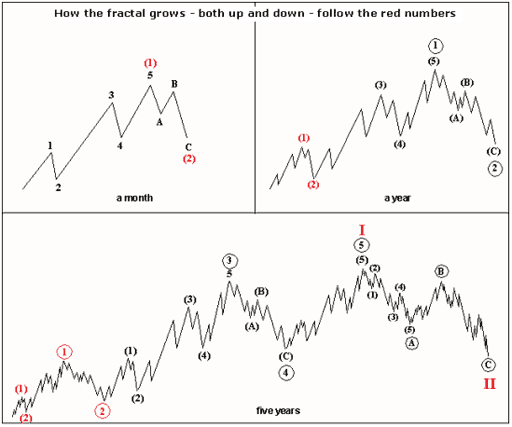
Figure 5: Motive and Corrective Elliottwaves at Different Degrees of Trend 
Figure 6: Fractal Market Structure at Different Timescales 
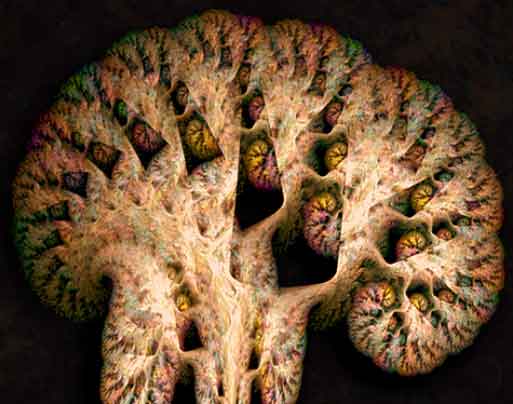
Figure 7: The Brain as a Robust Fractal 
Figure 8: Perception Versus Reality in Socionomic Causation 
Figure 9: Phase 1 of the Decline with Elliottwave Labels 
Figure 10: Diminishing Marginal Productivity of Debt in the US Economy 
Figure 11: Declining Marginal Returns to Complexity
Adaptive cycles are the foundation of both natural ecological and human socio-economic systems, and have been investigated independently from very different perspectives by ecologists and financial analysts who have almost certainly never heard of each others' work. It is interesting then to look at the strong correspondence of the self-similar hierarchical patterns, best described as fractals, which emerge from both fields. This form of organization seems to be a fundamental dynamic in many areas.
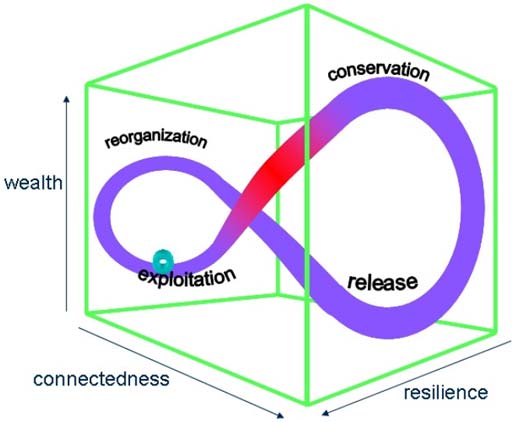
The bewildering, entrancing, unpredictable nature of nature and people, the richness, diversity and changeability of life come from that evolutionary dance generated by cycles of growth, collapse, reorganization, renewal and re-establishment. We call that the adaptive cycle.
Holling, 2009
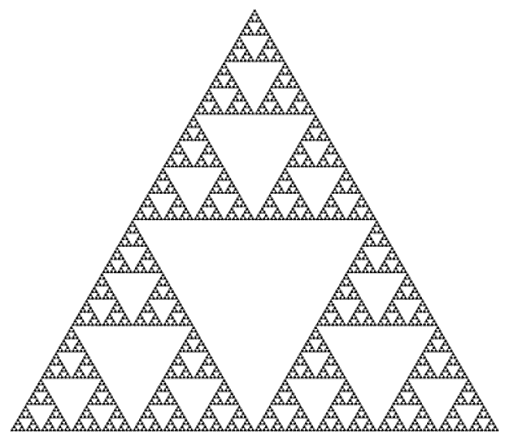
Holling, Panarchy and Resilience
Arguably the most significant thinker in the field of ecological cycles has been Buzz Holling, who refers to the conceptual model he derived from the study of forest ecosystems as Panarchy. Holling observed that ecosystems developed in adaptive cycles of exploitation, conservation, release and reorganization which could be described in three dimensions - ecological 'wealth', connectedness and resilience. These cycles provide a framework for the opposing forces of growth and stability versus change and variety.
In an adaptive cycle, early growth is rapid as individuals of many species arrive in a newly opened space and seek to exploit a plethora of vacant ecological niches. Genetic diversity and biomass, both living and dead, increase quickly in this expansion phase. Ecological connections are initially simple and sparse, but over time many interconnections and mutual dependencies develop. The system therefore increases in both 'wealth' and connectedness, as flows of energy and materials become larger and more complex. Biological 'wealth' confers the potential for novelty, allowing the system to adapt in disparate directions as circumstances warrant. Connectedness permits increasing stability, through the development of negative feedback loops, which help to regulate conditions conducive to life.
As time passes, rapid growth gives way to conservation. Inter-dependencies become highly specialized and self-regulation becomes fine-tuned and sophisticated. Efficiency is maximized as niches are fully occupied, and flows of energy and nutrients are tightly controlled by the existing biota. This represents the end of the growth phase. Relatively few opportunities are left for newcomers or novel strategies, hence diversity stabilizes or declines. The system is 'rich', but becomes more rigid, and therefore less resilient in the face of potential shocks, which can propagate rapidly through a highly inter-connected system with smaller margins for error than it had in its generalist phase. An increasingly brittle ecosystem becomes, in Holling's words, "an accident waiting to happen".
When something does push the ecosystem outside of the boundaries it can tolerate, the long growth phase can morph into a rapid and chaotic release and reorganization phase, where nutrients and energy stores previously tied up can suddenly be liberated. This can be associated with a considerable loss of complexity, but also with much greater potential for generalist strategies and for novelty.
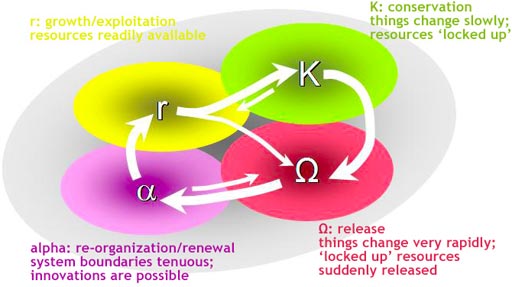
- During the growth phase the system finds an abundance of resources available. Expansion and exploration of new opportunities are key concepts within this stage. “When new ecological spaces open up – due, for instance, to forest fires, or retreating glaciers, or many other things- resources needed for other species to grow are made available. There’s more light reaching the soil surface when large trees are toppled, or burned to the ground, for example.”
- “The "r" phase is transitory, and as the system matures, it is replaced by the K phase. Eventually slower growing, long lived species or entities enter the system. Resources become less widely available as they become “locked up”… The K phase is sometimes called the conservation phase, because energy acquired goes into maintaining or conserving existing structure, rather than building new structure. In this phase, a few dominant species or companies or countries … have acquired many of the resources and are controlling the way they can be used.”
- “Often systems rapidly pass into a phase called omega. This is also referred to as the release (or creative destruction) phase because structure, relationships, capital or complexity accumulated during the r and K phases is released (often in a dramatic or abrupt fashion). … Plants may die … or a company may go bankrupt, releasing workers and decommissioning factories or offices.”
- “The fourth, or alpha phase, is a period of reorganization, in which some of the entities previously released begin to re-structure but not necessarily as they were before. This phase can mark the beginning of another trip through an adaptive cycle … Many new entities may enter the system, and innovation becomes more probable.” Project Shrink
However, such adaptive cycles do not exist in isolation. Local ecosystem cycles are embedded in larger and slower-moving regional cycles operating over years and decades, which are in turn part of global climate and elemental cycles (carbon, nitrogen, phosphorus etc) that may unfold over centuries or millennia. These larger cycles can act as stabilizing factors by adding a 'memory effect', or wealth reservoir, enabling rapid regeneration following a localized setback, but only if the larger cycle is not in its own contraction and reorganization phase. In addition to being part of larger cycles, dynamic ecosystems are also composed of smaller and faster-moving cycles of growth and decay, operating on much shorter time horizons. This nested set of self-similar structures allows for both persistence and innovation.
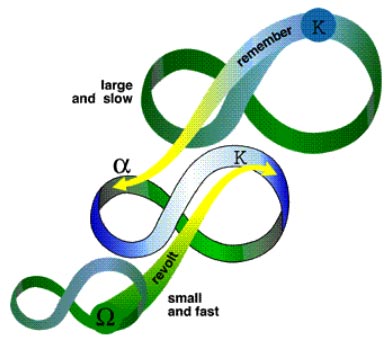
Where higher and lower order cycles are very tightly coupled, they may synchronize, becoming trapped in a extended growth phase at many scales at once, thereby risking synchronous collapse. This need not be triggered at a large-scale level, but can begin anywhere in a set of nested adaptive cycles and proceed both upwards and downwards. A destabilizing event arising from below, for instance a disease outbreak leading to widespread morbidity and further adverse consequences, is called a 'revolt'. A synchronous collapse, which can take the form of a "pancaking implosion", to use Holling's term, can lead to a poverty trap, or persistent maladaptive state characterized by low 'wealth' and connectivity, which is very much more difficult to recover from than a localized reversal would have been.
By way of illustration, the Canadian province of British Columbia is currently facing a confluence of circumstances that pose a significant large-scale ecological threat. A long-standing policy of fire-suppression, in a hitherto naturally fire-controlled ecosystem, has led to a thick understory of growth, which has in turn caused significant stress to trees forced to compete for water and nutrients in an area becoming warmer and drier. Trees under stress have much lower resistance to pine beetle infestation, with the result that a pine beetle population explosion is killing huge tracts of forest despite all efforts to contain the outbreak. This adds to the combustible material on the forest floor and greatly increases the risk of widespread conflagration. The much smaller self-limiting fires typical of the province would have opened up areas for new growth, killed insect pests and released nutrients for regeneration, and in fact are required by some tree species in order to open up seed pods for reproduction. In contrast, very large and intense fires, fueled by a tremendous excess of flammable detritus, can comprehensively denude enormous tracts of land. This can remove the biological reservoir of potential repopulating species as well as lead to enough soil erosion to inhibit regrowth of the forest ecosystem. An interlocking series of adaptive cycles has been synchronized through being locked into an extended growth phase and is therefore much more vulnerable to a catastrophic event that could become a lasting poverty trap.
When collapse occurs it can be a natural part of the pattern of adaptation and learning. That is what happens in forests when they burn or are attacked by natural enemies. Recovery typically replaces the old with a similar but new pattern that is similar because of the memory reserved in seeds and vegetation of the understory.
But when the collapse occurs as a consequence of long effort to freeze the system into one paradigm of development and management, then it might involve collapse of a level of the panarchy, which in turn threatens other levels. The collapse of ancient societies has this character- the top religious and political controls can collapse, triggering the gradual collapse of institutions till the family is left as the sole source of survival. It leads to a "poverty trap." Holling, 2009
Much of Holling's work has focused on the crucial role of resilience in both natural and human systems, and the Resilience Alliance has been the result:
We define resilience, formally, as the capacity of a system to absorb disturbance and reorganize while undergoing change so as to still retain essentially the same function, structure and feedbacks - and therefore the same identity.
Resilience arises from a redundancy that has the appearance of inefficiency and a lack of critical structural dependency on specialized hierarchy, neither of which conditions are likely to be met at the peak of the growth phase of an adaptive cycle. For these to be achieved from this point at least a partial, or localized, collapse to a simpler level of organization would have to occur. There can potentially be a fine line between a retreat from rigidity to this level of resilience and a 'poverty trap', where a collapse has proceeded so far and so fast that the system has been stripped of the wealth (biological or otherwise) that it would need to rebuild. Where adaptive cycles have become synchronized, so that the likelihood of deep collapse is increased, striking a balance of resilience would be far more difficult.
- A resilient world would promote biological, landscape, social and economic diversity. Diversity is a major source of future options and of a system's capacity to respond to change.
- A resilient world would embrace and work with natural ecological cycles. A forest that is never allowed to burn loses its fire-resistant species and becomes very vulnerable to fire.
- A resilient world consists of modular components. When over-connected, shocks are rapidly transmitted through the system - as a forest connected by logging roads can allow a wild fire to spread wider than it would otherwise.
- A resilient world possesses tight feedbacks. Feedbacks allow us to detect thresholds before we cross them. Globalization is leading to delayed feedbacks that were once tighter. For example, people of the developed world receive weak feedback signals about the consequences of their consumption.
- A resilient world promotes trust, well developed social networks and leadership. Individually, these attributes contribute to what is generally termed "social capital," but they need to act in concert to effect adaptability - the capacity to respond to change and disturbance.
- A resilient world places an emphasis on learning, experimentation, locally developed rules, and embracing change. When rigid connections and behaviors are broken, new opportunities open up and new resources are made available for growth.
- A resilient world has institutions that include "redundancy" in their governance structures and a mix of common and private property with overlapping access rights. Redundancy in institutions increases the diversity of responses and the flexibility of a system. Because access and property rights lie at the heart of many resource-use tragedies, overlapping rights and a mix of common and private property rights can enhance the resilience of linked social-ecological systems.
- A resilient world would consider all nature's un-priced services – such as carbon storage, water filtration and so on - in development proposals and assessments. These services are often the ones that change in a regime shift – and are often only recognized and appreciated when they are lost. Walker, 2008
This will be a very tall order in a panarchic future.
Prechter, Elliottwaves and Socionomics
Bob Prechter has also spent decades studying the structure of nested cycles, but in his case in financial markets, carrying on the work of RN Elliott, who established the field in the 1930s. Elliott painstakingly documented motive (impulse) and corrective patterns which unfold at all degrees of trend simultaneously - from small moves completing in minutes to larger cycles playing out over months, years, decades and longer. Elliott noted that motive waves in the direction of the one larger trend occur in fives, while corrective waves counter to the one larger trend form threes or multiples thereof.
Prechter explains that this is the minimum requirement for an adaptive cycle capable of both fluctuation and progress, and therefore the most efficient form. Each move itself is composed of the same patterns, while each also forms a component part of larger structures. (Motive waves are labeled with numbers, while corrective waves are labeled with letters.)
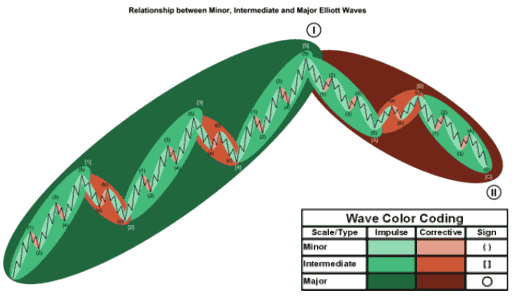
As opposed to self-identical fractals, whose parts are precisely the same as the whole, and indefinite fractals, which are self-similar only in that they are similarly irregular at all scales, a robust fractal is one of intermediate specificity. Though variable, its component forms, within a certain defined latitude, are replicas of the larger forms. Prechter, 1999, p17
Bob Prechter's socionomics model combines Elliott's observed fractal patterns with an understanding of human herding behaviour, comprising a comprehensive challenge to prevailing notions such as the Efficient Market Hypothesis by reversing causation and recognizing the role of emotional/irrational behaviour as the prime market driver. While the real economy demonstrates negative feedback loops, finance is thoroughly grounded in positive feedback.
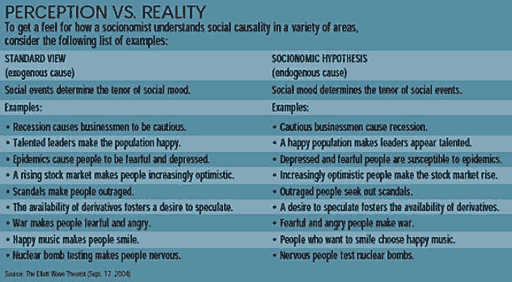
Socionomics provides a model of collective mood swings which permits collective human behaviour prediction in finance, the real economy and beyond. Consensus takes time to build, so that the more extreme the sentiment, the closer one is to a trend change. Collectively optimistic people engage in one range of behaviours over different timescales - typically buy stocks, borrow funds to build businesses, employ others in the expectation of profit, vote for incumbents whom they credit with stability, engage in cheerful expressions of popular culture and behave in an increasingly inclusive manner in recognition of common humanity. Collectively pessimistic people become increasingly risk averse and suspicious of others, in whom they look for differences rather than similarities. Both optimistic and pessimistic behaviours, particularly in their extreme forms, can create self-fulfilling prophecies for varying periods of time, until perception substantially overshoots reality and the trends it creates can no longer be sustained. The manic trend of recent years has led to an unsustainable debt burden of unprecedented scope and complexity. It also led to an unprecedented degree of global economic and financial integration dependent on hierarchical specialization, comparative advantage and just-in-time delivery that are clear examples of rigidity creating a brittle system.
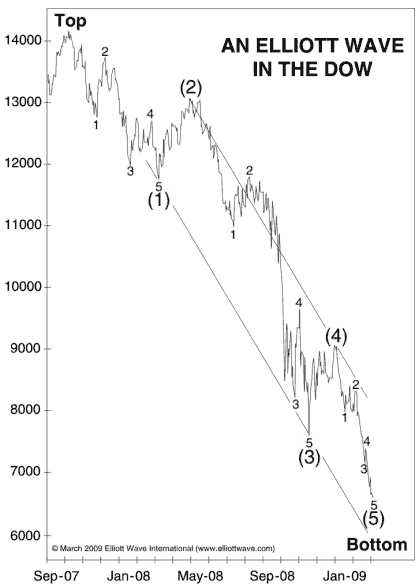
Like Holling's panarchy, Prechter's nested socionomic cycles either reinforce or counter each other depending on the direction of cycles larger and smaller than the one under consideration. Where cycles at several degrees of trend are moving in the same direction, the move will be extreme - either a mania to the upside or a crash to the downside. The largest mania ever known topped in the year 2000, and we have been in bear market territory since then (more obviously in real terms). We are now approaching a synchronized move in the opposite direction as the rally of recent months peters out in the face of the larger downtrend. The consequences of this will be considerable, but we are still quite near the beginning of the large-scale and complex downward pattern the model predicts will unfold over the next several decades. We can expect many deleveraging cascades and many intervening rallies, some larger than we have seen so far.
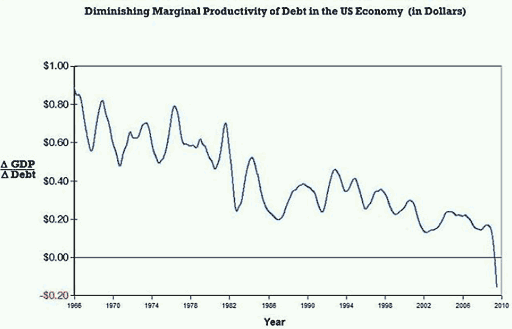
It is inevitable that the complex web of debt instruments and inter-dependencies that humanity invented to prolong its growth phase (to use Holling's terminology) by stealing from the future will be a prime focus for a sharp reversal, as we have already reached the point where additional debt provides less than no benefit. Socionomics tells us that the trust and complacency as to systemic risk that allowed this debt structure to develop will be primary casualties of a synchronized move to the downside, being both cause and effect in a powerful positive feedback loop.
Tainter, Complexity and Peer Polities
Joseph Tainter's work complements that of Holling and Prechter, providing a framework of diminishing marginal returns to complexity which encompasses ecosystems, individual societies and competitive peer polities. As complexity increases, it eventually becomes a liability, as we can see with Holling's description of rigidity reducing the resilience of ecosystems and Prechter's many writings on the debt complexity of manias and the systemic risk it engenders.
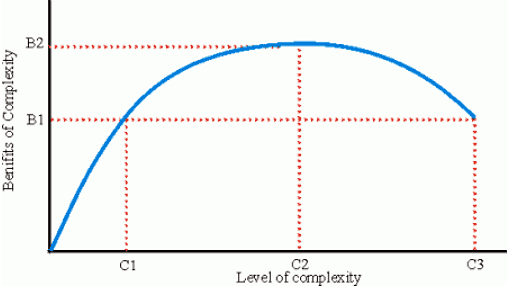
As with diminishing marginal productivity of debt, past a certain point further investments in complex solutions to increasingly complex problems has a negative return. Tainter explains, however, that where there is not a single political structure, but instead competitive peer polities, these entities become trapped in a competitive spiral where investment in organizational complexity must be maintained regardless of cost, as the alternative is domination by another member of the cluster at the same level of complexity, rather than collapse to a simpler system. The counter-productive actions of states are legitimized to the citizenry by the fact that each member of the cluster is engaging in the same behaviour. Collapse, which requires a power vacuum, is not possible unless the whole cluster collapses at once at the point of economic exhaustion.
Peer polity systems tend to evolve toward greater complexity in lockstep fashion as, driven by competition, each partner imitates new organizational, technological, and military features developed by its competitors. The marginal return on such developments declines, as each new military breakthrough is met by some counter-measure, and so brings no increased advantage or security on a lasting basis.. A society trapped in a competitive peer polity system must invest more and more for no increased return, and is thereby economically weakened. And yet the option of withdrawal or collapse does not exist.....Peer polity competition drives increased complexity and resource consumption regardless of cost, human or ecological. Tainter, 1988, p214
Tainter observes that the peer polity nature of the modern world creates a more apt comparison with the rapid collapse of the ancient Maya than with the slow decline of Rome. To use Holling's terminology, we have seen a panarchy of nested cycles synchronize, with the effect of artificially extending the growth phase for all simultaneously. The evidence for this is abundantly available in terms of the many limits to growth we are approaching or have reached, most notably the high EROEI energy required to maintain complexity. The significant risk is therefore of deep collapse over a relatively short period of time (although this would still likely be decades at least).
Collapse, if and when it comes again, will this time be global. No longer can any individual nation collapse. World civilization will disintegrate as a whole. Competitors who evolve as peers collapse in like manner. Tainter, 1988, p214
References
- LH Gunderson and CS Holling (2001). Panarchy: Understanding Transformations in Human and Natural Systems.
- RR Prechter (1999). The Wave Principle of Human Social Behaviour and the New Science of Socionomics.
- RR Prechter (2002). Conquer the Crash.
- RR Prechter (2003). Pioneering Studies in Socionomics.
- JA Tainter (1988). The Collapse of Complex Societies.
Postscript:
There are about three kinds of scientists - the consolidator, the technical expert, and the artist. Consolidators accumulate and solidify advances and are deeply skeptical of ill formed and initial, hesitant steps. That can have a great value at stages in a scientific cycle when rigorous efforts to establish the strength and value of an idea is central. Technical experts assess the methods of investigation. Both assume they search for the certainty of understanding.
In contrast, I love the initial hesitant steps of the "artist scientist" and like to see clusters of them. That is the kind of thing needed at the beginning of a cycle of scientific enquiry or even just before that. Such nascent, partially stumbling ideas, are the largely hidden source for the engine that eventually generates change in science. I love the nascent ideas, the sudden explosion of a new idea, the connections of the new idea with others. I love the development and testing of the idea till it gets to the point it is convincing, or is rejected. That needs persistence to the level of stubbornness and I eagerly invest in that persistence. Holling, 2009
(Original here).
A Net Energy Parable: Why is ERoEI Important?
EROEI on lihtne, loogiline, huvitav ja samas tähelepanuta (vähemalt minu teadvuse jaoks) jäänud indikaator. Uurime seda edasi. Mõtleme oma tulevikule ja kohalikele kinnisvarahindadele. Arikkel TheDrumOilist.
For most living things, energy is calories. Over eons, natural selection has optimized the most efficient methods for energy capture, transformation, and consumption.( Lotka) Cheetahs that repeatedly expend more energy chasing a gazelle than they receive from eating it will not incrementally survive to produce offspring.
For most living things, energy is calories. Over eons, natural selection has optimized the most efficient methods for energy capture, transformation, and consumption.( Lotka) Cheetahs that repeatedly expend more energy chasing a gazelle than they receive from eating it will not incrementally survive to produce offspring.
But humans, in a very brief evolutionary time span, have puzzled out how to unlock the hydrocarbon bonds in fossil fuels, freeing up vastly more energy that can be directly eaten. The vast majority of our per capita energy production is spent on non-nutritive exosomatic consumption. We have gradually, with rapidity at times, advanced modern human civilization to a global scale, with liquid fuel in jets, trucks, and automobiles providing the glue that links people and products together.


WHAT IS NET ENERGY?
To harness and consume energy requires some type of energy investment. This investment is what comprises the difference between gross energy and net energy. There is various nomenclature that describes this concept. Energy profit ratio, surplus energy, energy gain, EROI, and ERoEI all represent virtually the same relationship of how much energy we receive, relative to an energy input(dollars do not factor in). The most referenced metric in the Peak Oil literature is EROI or ERoEI (Energy Returned on Energy Invested), which, in its simplest sense is the ratio:
Energy Output / Energy Input
There is disagreement (sometimes dramatic) in the energy literature not only as to what should be included as energy inputs and outputs (a boundary issue) but how variables are included (how to evaluate co-products, how to include other limiting inputs to an energy technology, etc) These nuances will be covered in a subsequent post.
Net energy is typically given as per unit of energy invested. Thus:
EROI = Net Energy + 1.
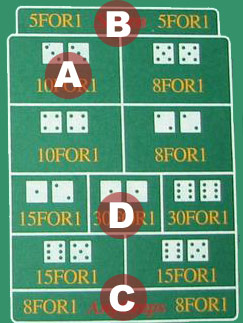
(For those of you who've played craps - some tables pay off the hard-ways FOR one and others TO one. EROI and net energy have a similar relationship. EROI is how much energy output FOR an energy input and net energy is the energy output TO the energy input.)
Net energy also can refer to a sum as well as a ratio. For an ethanol process that has an EROI of 1.2:1 -the net energy is just .2, but we can also calculate how much net energy is created for society in a given year or a life-of-resource total. At EROI of 1.2, the 3.9 billion gallons that the US produced in 2005 required 3.29 billion gallons of BTU energy input, resulting in a `net energy' of 610 million gallons. (This post will use net energy and EROI interchangeably - if a sentence uses EROI, just subtract one to get net energy, if I use net energy, just add one to get EROI)
A GROSS vs NET ENERGY GRAPH

Briefly, the above graph shows a theoretical depletable resource which follows the 'best first' concept of resource extraction. The vertical axis is quantity and the horizontal is time. The gross energy resource "X", is the entire area under the curve. ("X" = "A"+"B"+"C"+"D"). Direct energy costs are "D". Indirect energy costs (like tractors and highways and medical insurance and such) are "C". Environmental externalities (in energy terms) are "B". "A" represents the total net energy of the resource after costs have been subtracted. At any given point in time the EROI can be calculated by taking a ratio of the total area divided by the costs (depending on the boundaries). As can be seen, net energy peaks and goes to zero way before the total gross energy is depleted. (This graphic is from an upcoming paper on EROI by a colleague (Kenneth Mulder) and myself.)
ENERGY QUALITY
Energy quality is also relevant. From an economic standpoint, the value of a heat equivalent of a fuel is set by its price, energy density, physical scarcity, cleanliness of the fuel, capacity to do useful work, flexibility, safety, conversion aspects, etc. (1)
(Source - Neal Elliot - ACEEE)

Electricity is currently the highest quality energy we have in our society, largely due to its ability to do work. Although crude oil is of lower energy `quality' than electricity, its use is ubiquitous in allowing other segments of society to transport goods, etc. and its `quality' as measured by price, has been increasing relative to electricity in recent years.
Cutler Cleveland et al. devised one method of `quality correcting' the net energy of oil and gas extraction using, The Divisia Index, which accounts for energy quality of both inputs and outputs(1 )Below is a graphic of the the thermal and quality corrected EROI of US oil and gas extraction.

"The Divisia EROI is consistently much lower than the thermal equivalent EROI. The principal reason for this is the difference in the fuel mix, and hence fuel quality, between the numerator and denominator of the EROI. The outputs are the crude, unprocessed forms of oil and natural gas. The inputs are electricity and refined fuels such as gasoline and other distillate fuels. The latter are higher quality than the former, and have higher prices. Refined fuels and electricity are, therefore, weighted more heavily in the Divisia formulation."(1)

In the 1930s, US oil was easy to discover. In many cases it was almost at the surface and had an EROI of discovery of 100:1.(2). It has since declined, depending how one measures it or who one talks to, in the range of 10-15:1. As it gets deeper, harder to find, more viscous, higher sulfur content, etc, the EROI will continue to decline. A typical refining efficiency is about 10:1, so the total refined EROI of our precious liquid fuel is still between 5-10:1. This may not seem so high (compared to 100!), but how many stocks have you owned that make 500-1000%? On each iteration? This is the type of energy subsidy world society has become accustomed to.(My paucity of references for this segment gives evidence to how little concern our leadership has for the issue of net energy. Charles Hall, (with data from John S Herold and Co.) and others are working on new updated oil and gas EROI numbers - but solid energy data is either proprietary or difficult to assimilate)
WHY IS NET ENERGY IMPORTANT?
We all intuitively know the difference between net and gross - we use the concept everyday. If you make $100,000 per year in salary and the government takes 38%, your net is $62,000. If the government took 99%, it really wouldnt matter whether you made $100,000 or $1,000,000, your take home would be very small. The same concept applies to energy, and in particular, whatever energy source is most central to society. Basically, net energy matters because net energy is what we use.
"Energy gain, or EROI, varies with the quality (transformity) of a resource deposit and with the efficiency of the technology used to locate, extract, process, distribute and exploit the resource. As the ease of obtaining or using a resource declines, more energy must be devoted to these activities, causing energy gain to decline. Where an energy budget is substantially constant, allocating more resources to energy production reduces the amount of energy available for other activities. The potential impacts of such a situation on a human system include less leisure time, a lower standard of living, higher taxes, and an increase in childhood mortality. In an animal population, allocating greater effort to energy production may mean less winter fat, increased embryo resorption, lower birth weights, or the like.Tainter(3)
It is fundamentally impossible to maintain a constant level of net energy while the aggregate energy profit ratio drops. Only after the energy profit ratio and the need for new fuel related level off can net energy supplies return to the desired level (4).(This book, Beyond Oil, is 20 years old, but is probably the best book on the concepts of net energy, agriculture and society)

We are currently living in the highest energy gain era of any organism in the history of earth. Although the total amount of BTUs consumed in 2005 was higher than any year in history, world energy per capita peaked in 1979.(5)(One could argue that the plateau in net energy per capita has been maintained by a large wealth transfer from poor to rich, from future to present, and from abstract 'energy' (debt) to real consumption).
There are a finite amount of stored fossil fuels on the planet. Some of the largest, highest quality resources have already been exploited. The remaining resources are in many cases more energetically difficult to harvest, or have negative side effects (e.g climate change and coal).
"Environmental degradation is greater when the resource is of low quality and distributed but heavily used. Thus, a switch to renewable energy sources might bring, ironically, environmental damage comparable in scale to, or greater than, that caused by the use of fossil fuels." (Joseph Tainter)(2)
We already see evidence of this in some of the scaling of biofuel production in Asia
A NET ENERGY PARABLE
Net energy of corn ethanol examples and debates have been presented ad nauseum from both proponents and detractors. The redundancy is trivializing the concept. Though the ethanol debate is critically important in deciding how to deploy of our remaining fossil energy, what follows is a more benign example:

A civilization of 1000 sasquatches lives on a small distant Planet P. They require only food (energy) and water to live but also enjoy a vibrant culture with artisans, builders, and craftspeople. Sasquatches are vegetarians (as everyone knows) but do raise animals for labor help, namely Hephalumps. These animals help them harvest large hempy plants from the mountain near where they live and process them into Saspacks (the finest, sturdiest, durable backpacks in the universe). Each week (which is 10 days long, based on Planet P's sun), the sasquatch colony works very hard for five days and then has leisure time during for the next 5 days. Once a year, a ship from Planet X lands and trades luxury food items (non-caloric but tasty), medicine, comic books, and basic materials in exchange for an agreed upon cargo of Saspacks.This societies only source of energy(calories) is Waybread, which is a highly energy dense cake made with Spice, water, and the meat from the Mongo nut, which grows in an enormous grove 25 miles from the sasquatch community. Once a Ten-Day, a troupe of the strongest 300 sasquatches traverses 25 miles to the Mongo nut groves, fills up their packs with nuts, and returns home with their energy bounty. It is a one day grueling journey across the Black Plains and through the Black Swamp but they make a ritual of it, telling stories and laughing most of the way until they arrive late at night. They spend a second day climbing trees and picking Mongo nuts, laughing at the colorful monkeys that play in the Mongo trees as well as picking some flowers to bring home to their wives and girlfriends. On the third day they leave at the crack of dawn and are home by nightfall. These same 300 sasquatches then spend two more days, cracking, pounding and combining ingredients together with the nuts to make Waybread; enough for the entire community for the next Ten-Day. All these sasquatches do no other work or leisure on the days they are procuring energy for the tribe. In return, they receive exalted status as the tribes energy providers, and a five day rest.
Since Sasquatches are freakin' huge, each member of their society consumes 4 m-cals a day. They really only require 3 m-cals to survive, but the extra makes them fat and hearty and also contributes to general gastronomic pleasure (sasquatches do not like to feel peckish). Hephalumps are even bigger and the 100 strong herd each requires 8 mcals per day of Waybread to survive and function. Although Waybread is highly nutritious, it is also highly perishable, and must be consumed within one Ten-Day, after which time it gets wormy, and gross.
During the five-day ritual of energy harvesting and preparation, 600 other tribal members are busy harvesting fiber from the mountain, and weaving and stitching it into Saspacks. The remaining 100 bigfoots, mostly youngsters, clean and maintain the village, manage the water supply from the river, and comb the hillsides for Spice. At the end of the fifth day, a feeling of joy emerges in the community as the tribe can look forward to relaxing, dancing and sleeping for five straight days, with plenty of Waybread for everyone. This routine has been going on for as long as any sasquatch can remember. None of them could imagine anything otherwise.
We can determine the energy gain (or net energy) of this society based on the above information. First let's look at the energy output:
Each of the 1000 sasquatches eats 4 mcals per day and there are 10 days per week on their planet. This equates to 40,000 mcals energy consumption per Ten-Day. Each of their herd of 100 Hephalumps requires 8 mcals per day (8,000 mcals per Ten-Day) Therefore the Mongo nut energy source provides them with a flow of energy of 48,000 mcals per Ten-Day. This is their energy output, which is entirely consumed.
How much energy does this society spend in order to get the 48,000 mcals? Well, 300 sasquatches work/travel for three days to acquire the Mongo nuts and then spend two days refining it into edible quality. They have to eat for nourishment during this time otherwise they would not have the strength to do work. Their caloric input (from the prior week's waybread) is 300 sasquatches times 5 days times 4mcals equals 6000mcals.
The energy gain for this society is 48,000 mcals less 6,000 mcals equals 42,000 mcals per ten-day.
The EROI is 48,000mcals/6,000mcals =8:1. The net energy is EROI-1 or 7:1. (Remember, EROI is FOR one and net energy is TO one.) For every unit of energy spent in energy harvesting/refining, 8 are produced. Since they used one unit to produce 8, 7 are left over for other areas of society. (Of the 48,000 mcals of energy available to their society, 6,000 is used for energy production, 12,000 is used to make Saspacks, 2,000 used for cleaning and water procurement, 8,000 to feed the Hephalumps and 20,000 to sustain the tribe during their 5 days of hedonistic leisure.) Sidenote -even though there is a 8:1 EROI, 30% of the tribes members contribute to energy procurement.
One day, the 300 energy procurers arrive at the Mongo grove and find many of the colorful monkeys lying dead on the ground. They were so disturbed that they carried 2 of the carcasses home to show the shaman. They also discovered that the Mongo nuts were no longer as easily reachable from the ground and they had to go either deeper into the forest, or climb higher up the trees to fill their packs with the largest ones. This ended up taking a whole extra day.The phenomenon of `best-first' apparently applies to Mongo nuts as well as oil. We can now calculate an updated net energy for the sasquatch society. The energy production was the same, at 48,000 mcal per Ten-Day. But the 300 sasquatch energy team now worked 6 days per week requiring 4mcal per day or 7,200 mcal. Also, 100 workers spent 2 days per week (on average) exploring and looking for other Mongo nut sites. From a societal perspective, this `energy exploration' expenditure of 100*4*2=800 mcals should be included (somewhere) in any net energy calculations even though it didn't directly result (yet) in energy production.After returning home a day late, the community was in a panic. They would have to spend a day out of their Five-Day to finish the procurement of food! And the sight of the dead, dark colored monkeys made many sasquatches cry. It was decided to call an emergency Council, to determine what might be done about the turn of events. Many wise and respected sasquatches voiced their opinions. They were saddened by the dead monkeys, but they were more concerned about the lack of easy to find Mongo nuts - the implications being the 300 energy workers might have to work MORE than 5 days per Ten-Day. One of the senior males suggested "We could save a little time by not stopping to pick and bring home flowers which aren't really needed for our energy supply". A matriarchal sasquatch immediately stood up and chastised "Zeke-Stinky-foot, you come home without flowers and you'll see how much they are needed, Husband-mine!". There was a vote and it was decided to continue to pick and bring home flowers.
During much arguing and debating, the shaman entered the pavilion and everyone quieted down. He exclaimed "Colorful Monkey-friends die from Black poisoning" A sharp intake of breath from the Council-members. "Our energy providers feet put Black Desert and Black Swamp on Mongo trees while they pick nuts. Colorful-monkey friends get on paws then in mouth then die." The Council went into an uproar - Black poisoning! Because of our energy procuring! How awful! Yet what can we do? - We need the Mongo nuts to survive and have energy to work and sing! And if we go around the Black Desert and Black Swamp it will take an extra day in both directions!!" The sasquatches were very upset, and spent most of their Five-Day arguing and trying to make a new plan, where none had ever been needed before. It was decided by the Council to have the 300 workers spend an extra day at the groves to fill up their packs. The Shamans comment about the Black Desert being carried to the trees, and killing monkeys was only talked about by a few, and drowned out by the sasquatch leaders who really wanted at least 4 days of leisure and 4mcals per day. It was also decided to send 100 of the 600 saspack workers on exploratory missions, something that hadn't been done in generations, to see what was beyond a 25 mile radius of their community.
These plans worked out reasonably well and gradually the sasquatch colony adjusted. After all, they still had the same amount of food and energy, even though they had to work slightly harder for it, and produce a few less Saspacks. At the end of each Ten-Day the sasquatches were not quite as well rested, but were happy in their resolve to work a little harder to get energy for the tribe. (The Hephalumps did not notice any of this, and continued to chew their 8,000 mcal of Waybread per week.)
The updated EROI formula is:
Energy output = 48,000 mcal/Energy input =8,000 mcal = EROI of 6:1 (net energy of 5:1)
Now of the 48,000 mcal of production, 8,000 is used for energy procuring, 11,200 is used for industry (Saspacks), 2000 for village maintenance, 8,000 for Hephalump food and 18,800 for leisure. Everyone in the sasquatch civilization still consumed the same amount of energy as before, but societies mix of labor allocation and free time had shifted.
***Sidebar of interest: We also now have information to calculate a more advanced (thorough) form of EROI, one that includes co-products and externalities. Flowers have value to sasquatch society and as such get a `co-product' credit in the EROI calculation. (much like dry distiller grains in the ethanol calculation) Since they are an additional output, we can reduce the amount of energy allocated to getting the Mongo nuts, as some of the sasquatch caloric expenditure is now considered necessary for getting flowers. How we allocate this is a debated but relevant question. We could take the market price of the two products (sasquatch society has none) or allocate by mass( the flowers have 50% of the mass of the Mongo nuts) or by volume (they are very light - only 10% the weight of nuts).
Allocating by mass would increase the EROI quite a bit:
Energy output = 48,000 mcal Energy input =4,000 mcal (4,000 allocated to flowers) = EROI of 12:1 (Net energy of 11:1)
Allocating by weight would increase the EROI slightly:
Energy output = 48,000 mcal /Energy input = 7,200 mcal (800 allocated to flowers) =EROI of 6.66:1 (Net energy of 5.66:1)
Our market system (in my opinion) underestimates the long term value of energy to society and net energy calculations that give so much `energy credit' to things like Dry Distiller Grains, thus overestimate the true energy gain (or underestimate the energy loss).
Regarding externalities, it is difficult to put an energy cost on dead monkeys. However, the poisoning was clearly a direct result of the sasquatches energy harvesting techniques and to exclude it from an energy analysis would not be holistic. Modern EROI analysis is just starting to value externalities as costs (see Patzek and Pimental regarding soil mining and Life Cycle analysis of GHG emissions) Ecological economics attempts to value things that humans need and value but are considered `free' in the market system. Quite possibly, the limiting factor of large scale ethanol production, even cellulosic, is the degradation of soil and assumption of continued ease and availability of irrigation.
Since sasquatches are a peaceful and conscientious race, lets arbitrarily allocate a high energy cost to the biodiversity loss to their culture of 8,000 mcals. The EROI would then be:
Energy output = 40,000 mcal (8,000 were subtracted) / 8,000 mcal energy input
=EROI of 5:1 (net energy of 4:1)
Continuing with our story:
The sasquatches situation, largely beyond their control, deteriorated further. The Mongo nut supply, while still enormous, was becoming more thinly distributed. Also, the nuts, which once averaged 3 lbs were now mostly 1-2 lbs. It took the sasquatches much more time and effort to pick and organize them. It also took more time to process them into Waybread, as the shell to nut ratio had increased substantially. All in all, it took an additional 100 sasquatches (400 total) a total of 7 days to harvest and process the Waybread. They were not beginning to get restive.One day, while the stressed sasquatch community was hard at work on what was normally their 7th day (2nd of leisure), a troupe of youngsters came running full out into the village "We are saved! We are saved! - We found a new Mongo nut grove with huge nuts and plenty of them!! We'll soon be able to go back to our old routine of dancing and reading comic books! For a Five-Day! These nuts are huge!"
A Council was hastily convened where the youths were eagerly bombarded with questions: "How big was the grove? Were there colorful monkeys? Would you like some water? Have you met my daughter Fern-Blossom?" An old silver-back sasquatch, one of the tribal leaders, stood up and quietly asked "Sons, how far is this grove?" One of the scouts replied "Sir, its 120 miles on the other side of the mountain, but an easy walk, with no Black Swamp or Desert". The leader nodded: "That is 5 days in each direction. If we send our energy workers that far, there will not be enough time for them to process the Waybread upon their return." He paused, "However, our Mongo nuts close to the village are getting smaller. I think we should go harvest this new, bigger energy source you have discovered. We will have to take more of our Saspack workers and our village cleaners too. But you are right, you have saved us."
When everything was sorted out, the sasquatches had to organize 2 energy procurement teams of 375 sasquatches each. One team brought water from the village and met the other team halfway and then returned with the large Mongo nuts to process them. These teams traded off in their duties but worked 8 days total out of every Ten-Day. This left 200 sasquatches to work on the saspacks, and it was decided, to be fair and because they were behind contract, that they also work an eight-day. There were only 50 of the tribe left to work on cleaning, and basic village maintenance. The community was amazed that so much! of their time was spent making Waybread, just to spend it on making more Waybread - very little singing and relaxation time anymore. After a few months, the tribal leader, at a somber Council meeting, announced that everyone would have to cut back, and strict rationing of daily consumption to 3 mcals per sasquatch would be enforced.
Because of the reduction in Saspack labor time, the Hephalumps weren't all needed and some started to roam the village. A large controversy erupted when one of the energy workers, strained from a long ten-day on the road, hit a hephalump on the head and killed it. He wanted to eat it but didn't know how.
The energy gain of this society continued to decrease. The energy output of 48,000 mcal (before the rationing), had an energy input of 750 sasquatches times 4 mcal times 8 days = 24,000 mcals.
The EROI was 48,000 / 24,000 =2:1 (Net energy of 1).
A large portion (50%) of this societies efforts were now allocated to energy procurement. Of the total 48,000 mcals procured, 24,000 was from energy procurement, 8,000 was for their livestock, only (200*8*4mcal) =4,800 mcal devoted to Saspack production, and 1,200 to maintain the village and procure water and 10,000 mcals for leisure and art.
A further problem, (for which I dont plan to attempt the math) was that WATER, not energy was now a limiting factor in the energy harvesting process. Water was much heavier to carry than Waybread so a cache had to be set up midway between the water source and the Mongo nut source. The Energy Return on Energy Invested stood steady at 2:1, but the Energy Return on WATER Invested, was declining dramatically.
After the tribal decision to ration consumption, the energy gain of society upticked. Since each sasquatch only consumed 3 mcals, (and many noticed new clarity of thinking and vitality after initial grumbling), the energy production requirements tapered off a bit:
The tribe still procured the same amount of Waybread (the extra was allocated to the following weeks Mongo picking team). The energy input was now only 750 *3mcal *8days = 18,000 Mcals. Because of their belt tightening (or efficiency) the societal EROI increased to 48,000/18,000 = 2.66 (net energy 1.66).Note: the EROI of energy procuring didnt change, but the societal energy gain, from a Tainter-like perspective, did increase.
At year end, the spaceship landed from Planet X. (There were 14 female sasquatches, and one male, waiting at the landing port, hoping to be rescued.) The alien trader strode down the ships conveyor and frowned when he saw the somewhat disheveled sasquatch community. There were Hephalumps everywhere (a delicacy on his planet), huts and sidewalks were in disrepair, and the tribe looked thin.He was greeted by the tribal leader who sheepishly stated "Noble trader, our energy supplies have dwindled and we had to spend extra time harvesting a new energy source so only had time to make 3,200 Saspacks, not the 6,000 per our agreement."
The alien snorted, "Silly sasquatches - your world, though small, is FULL of energy - what you call the Black Swamp is also known as crude oil and what you call Black Desert is called coal-both of these substances have way way more energy than your precious Mongo nuts. Since you are good customers, I will give you your materials and ½ the medicine but withhold the tasty treats and comic books until you can make more Saspacks. If you like, I will bring machinery to your planet and help you to harness your Black Swamp, in return for great riches" The community was saddened and confused. How could the Black Desert be strong energy? It was poison. They held an immediate Council and concluded that they could do without the comic books, materials and candy. The local shaman could find his own medicine, and they would continue harvesting Mongo nuts, but would further divide the labor among the tribe and produce Saspacks no more. They also didn't need the Hephalumps anymore and would lead them to the Mongo groves and leave them free next Ten-Day. They waved goodbye to the galactic trader for the last time.
The sasquatches were transitioning from a high to a low gain energy system. By removing the Hephalumps and the Saspack industry, which brought them niceties that they didn't really need, they now only had to procure 30,000 mcals per ten-day. The energy input was still 750 *3mcal*8days = 18,000 Mcals.
The final EROI in our example is 30,000 / 18,000 = 1.66:1 (Net energy of .66). While lower, the community now had reorganized in such a way that 18,000 mcal went to energy procurement and 12,000 were left for leisure and dancing and singing (40% of all energy).

CONCLUSIONS
Sasquatch civilization underwent a decline in net energy. The results were less industry and less free time, as a larger effort had to be made to procure essential food. Eventually, they partially offset this loss in energy gain, by jettisoning certain aspects of their culture that were energy intensive yet did not really provide the satisfaction that it cost. The situation of the Sasquatches is not that different from our own. Our assets are human ingenuity, 1.2 trillion barrels of oil, 179.8 trillion cubic meters of natural gas, and 909,064 million tones of coal (of various qualities)(source BP), and the various renewable flows generated from the planet. Our liabilities are a large population, the seemingly unquenchable human desire for more, a growing realization that we have in fact tapped the 'best-first' energy reserves, and ecosystems that are nearing the limits of their resilience to human extraction and waste absorption.
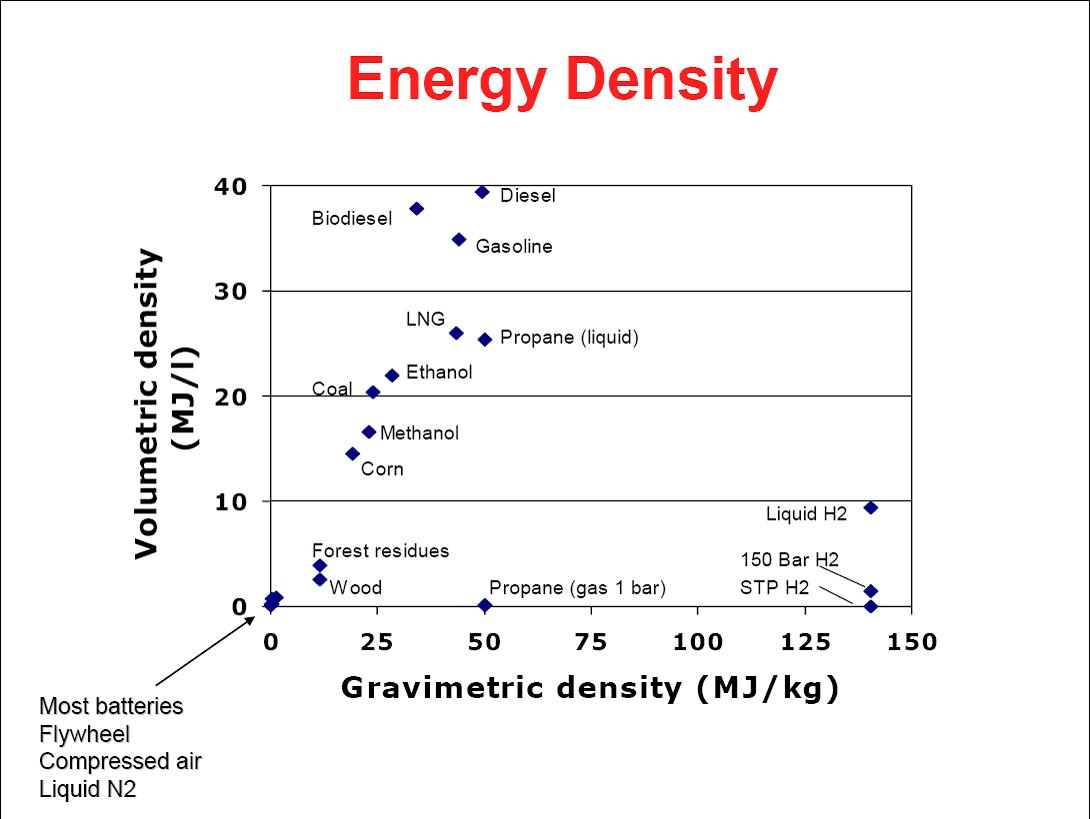
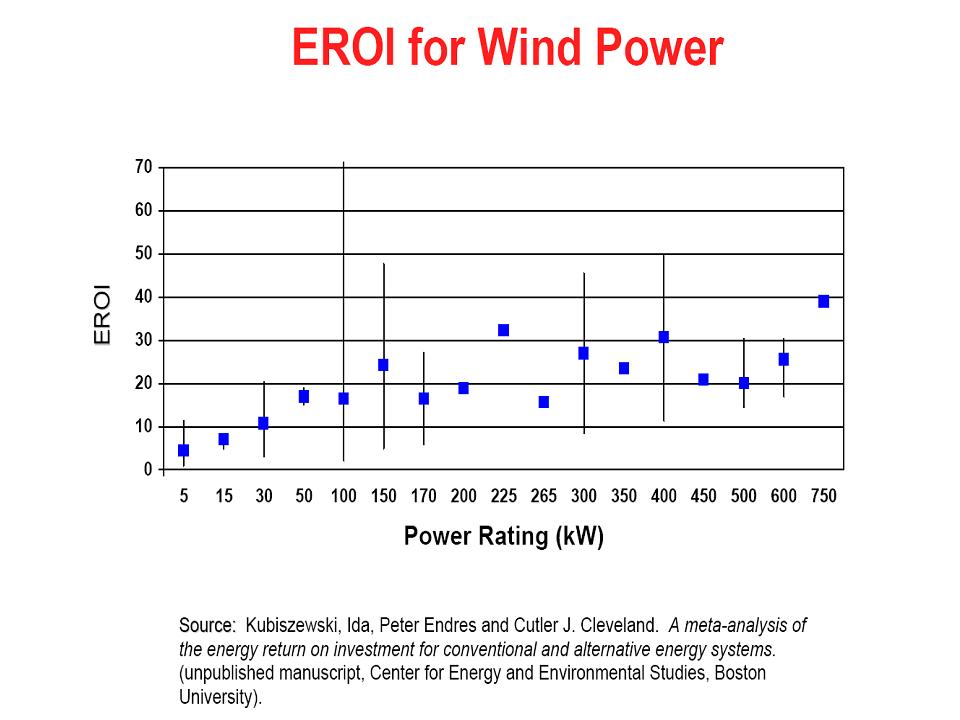
Our civilization is organized around high energy gain infrastructure - low gain sources, possibly even as low as 5:1 may not have the energy density required to power our liquid fuel intensive society. As can be seen by the below graphic, shopping centers and skyscrapers are part of a high energy infrastructure. Renewable flows, at least thus far do not match up in energy gain. Large scale wind has a higher EROI than oil, but cannot (as of yet), power our planes, trains and automobiles.

(Graphic from Cutler Clevelands EROI powerpoint.)
The corn ethanol and even the cellulosic ethanol debates typically miss a larger point. Much mental effort is spent debating whether the energy balance is slightly positive or slightly negative while society runs on an energy gain significantly higher than any liquid fuel alternative. When we hit $150 oil, there won’t be too many parents buying their kids a new GI Joe with the Kung Fu grip toy. At the same time, energy companies will need more and more employees to man wildcats and oil rigs and install solar panels. Though we might not be thinking in these terms at the time, the lack of energy gain (or lower net energy) will be manifesting itself in resources taken away from marginal areas of society (toy companies, hot tubs, hemorrhoid cream, Snausages, poker chips, etc) into energy producing and distributing sectors.
THE BOTTOM LINE:
1) Net energy is more important from a relative basis than absolute. A 3:1 EROI doesn't tell us much unless we know how that compares to what an organism/society has been built on/used to. A 2:1 EROI would have made stone age villagers incredibly rich. A 5:1 EROI may not be enough to power our society. (e.g. as fossil fuels get more expensive they will collapse the economy and no real recovery will ever happen as the high energy gain outputs are already gone)
2) Energy reserves are not as important as energy flow rates. We could have a billion mongo nut trees, but all that matters is the maximum flow that society is able to harvest in real time. (This obviously applies to oil as well)
3) Energy quality depends on the context. High BTU substances, like oil or coal, are clearly very useful to our society, but may not be to others. (the sasquatch colony valued and used Waybread, not oil)
4) Liebigs law of the minimum applies to an energy portfolio. Wind has a high EROI, but our system infrastructure relies on liquid fuels. The net energy of the weakest link matters more than the overall net energy of society. (Adding high EROI wind capacity while net energy of oil dwindles does not solve the problem, unless the energy mix changes from liquid fuels to electricity)
5) Using different boundaries in net energy analysis will lead to different conclusions. A society running at 5:1 EROI would be happy to develop a scalable technology with an 8:1 EROI, however, after environmental externalities are included, it might only be a 3:1 technology. (Coal-to-liquids and climate change comes to mind) The difficulties lie in making meaningful comparisons and valuing important life functions not priced in the market system.
6) Rather than pursuing the highest and most promising energy technologies, it might be prudent to pursue ones that are certain, and meet the net energy decline half-way by reducing energy footprints. As we decline in aggregate societal energy surplus, a great deal of remaining energy is going to be wasted, ostensibly going after 'more oil and gas', which will likely be unprofitable both monetarily and from energy perspective.
7) Since evolution has favored organisms that have the highest energy output energy input ratios, it will be a cognitive challenge for us (as organisms) to willingly reduce the numerator.
8) Consumption, in the sasquatch example, continued very high until late in the game, and was subsidized from borrowing from other aspects of society. Lack of energy gain was a phantom concept until the situation was much deteriorated. Similarly, in our current fiat based civilization, we might 'replace' the lower energy gain by printing money or relaxing financial requirements, but these measures will not be based on anything biophysical and make the eventual crash much steeper. In the end, it's not about how much energy we have but how much societies can afford via real inputs.
Our collective task will be to improve our net (total cost) energy from renewables while changing the infrastructure of society to best match what our long term sustainable energy gain can be.
-thelastsasquatch (a.k.a. nate hagens)
(1) Net Energy from the Extraction of Oil and Gas in the United States. Cutler Cleveland, Boston University
(2)Hydrocarbons and the Evolution of Human Culture, Hall et al. Nature Novermber 20, 2003
(3)Resource Transitions and Energy Gain, Tainter et al. Conservation Ecology 2003
(4) Beyond Oil: The Threat to Food and Fuel in the Coming Decades, Gever et al, 1986 Ballinger Publishing
(5) The Olduvai Theory: Energy, Population and Civilization, Richard C Duncan, The Social Contract Winter 2005-2006
Wednesday, January 6, 2010
Mike Ruppert: The world is falling apart
Mike on majas värske artikliga, emotsionaalselt dramaatiline nagu vaja.
JAN 3, 2010 -- As I write, the world is falling apart. Military forces from all major powers are flooding the Gulf of Aden, using piracy and terrorism as a pretext. This is all jockeying in anticipation of a major, and possibly total, war in and around the Persian Gulf -- where 60% of the planet's known oil is. Pakistan is imploding. Within days it will face a "worst possible" energy crisis and, according to Pakistani news sources, trigger massive civil unrest. Pakistan has failed. An Israeli and/or U.S. attack on Iran is now, no longer unthinkable. Just recently, Israel recalled all its ambassadors and charges d'affaires simultaneously for what (sure looked to me) was an emergency huddle. Major power shortages are crippling nations from the Phillipines, to Vietnam, to India, throughout the Caspian and especially Pakistan. Cities in many countries (including the USnd Britain) are selectively turning out streetlights that will never come back on because they can't afford the cost. The world is starting to shut down.
Sovereign default is a threat throughout Europe and especially in Greece and the United Kingdom. There are signs that the U.S. economy has started to implode. I will join my good friend, the brilliant James Howard Kunstler, in predicting a DOW at 4,000 in 2010.
President Obama has just ordered massive governmental preparation for a biowarfare attack. Something evil this way comes, and it will be worse than 9-11. Those who have followed me regularly over the years know that I have never gotten excited about any of a score of rumors of another attack. I was the last to get excited because I trusted the map we were making. It proved accurate.
It still is and I am scared sh***ess. But I am not panicking. I'm trusting the map. We made it together. We're on this ride together.
With the movie Collapse doing well and the book selling strongly I appreciate the risk I'm taking with my credibility, and that I am inviting attacks for issuing this statement. It has been estimated that over a decade my predictions have been 80 per cent accurate. (I never kept count.) I pray to God that this is one of those 20 per cent that I get wrong. To all of you who I love and to whom I owe so much, I recommend that you make a small investment in potassium iodide tablets for yourself and your family. It's time to start running faster than the other campers.
And with all of that you should hear the songs the New White Trash are writing and recording. You will very soon. I am so proud to be a part of this band. Music will make the birth of the new paradigm easier to take. I've been listening to Taj Mahal all day.
Subscribe to:
Posts (Atom)