- Humans are currently emitting around 30 billion tonnes of CO2 into the atmosphere (CDIAC). Of course, it could be coincidence that CO2 levels are rising so sharply at the same time so let’s look at more evidence that we’re responsible for the rise in CO2 levels.
- When we measure the type of carbon accumulating in the atmosphere, we observe more of the type of carbon that comes from fossil fuels (Manning 2006).
- This is corroborated by measurements of oxygen in the atmosphere. Oxygen levels are falling in line with the amount of carbon dioxide rising, just as you’d expect from fossil fuel burning which takes oxygen out of the air to create carbon dioxide (Manning 2006).
- Further independent evidence that humans are raising CO2 levels comes from measurements of carbon found in coral records going back several centuries. These find a recent sharp rise in the type of carbon that comes from fossil fuels (Pelejero 2005).
- So we know humans are raising CO2 levels. What’s the effect? Satellites measure less heat escaping out to space, at the particular wavelengths that CO2 absorbs heat, thus finding “direct experimental evidence for a significant increase in the Earth’s greenhouse effect”. (Harries 2001, Griggs 2004, Chen 2007).
- If less heat is escaping to space, where is it going? Back to the Earth’s surface. Surface measurements confirm this, observing more downward infrared radiation (Philipona 2004, Wang 2009). A closer look at the downward radiation finds more heat returning at CO2 wavelengths, leading to the conclusion that “this experimental data should effectively end the argument by skeptics that no experimental evidence exists for the connection between greenhouse gas increases in the atmosphere and global warming.” (Evans 2006).
- If an increased greenhouse effect is causing global warming, we should see certain patterns in the warming. For example, the planet should warm faster at night than during the day. This is indeed being observed (Braganza 2004, Alexander 2006).
- Another distinctive pattern of greenhouse warming is cooling in the upper atmosphere, otherwise known as the stratosphere. This is exactly what’s happening (Jones 2003).
- With the lower atmosphere (the troposphere) warming and the upper atmosphere (the stratophere) cooling, another consequence is the boundary between the troposphere and stratophere, otherwise known as the tropopause, should rise as a consequence of greenhouse warming. This has been observed (Santer 2003).
- An even higher layer of the atmosphere, the ionosphere, is expected to cool and contract in response to greenhouse warming. This has been observed by satellites (Laštovi?ka 2006).
Wednesday, August 11, 2010
Soojenemise loogika
The NOAA State of the Climate 2009 report is an excellent summary of the many lines of evidence that global warming is happening. Acknowledging the fact that the planet is warming leads to the all important question: What’s causing global warming? To answer this, here is a summary of the empirical evidence that answer this question. Many different observations find a distinct human fingerprint on climate change:

Tuesday, August 10, 2010
Norwegian Company Designs Giant 10MW Wind Turbine
The size demands an entirely new offshore wind design
A majority of the wind farms in the United States use 2.5 megawattwind turbines
, and recent technology has introduced even larger turbines at 5 megawatts. Europe, on the other hand, is racing ahead of the game with the largest wind turbine yet - 10 megawatts. And it may be changing the way wind turbines are designed altogether.
Europe has seen a lot of advantages to building larger wind turbines, such as avoiding environmental issues by using larger turbines in deeper waters. There is less of a risk of encountering environmental problems the further offshore the turbines are located. Europe seems to build larger turbines as the water grows deeper, as well.
Another advantage to building larger turbines is the cost. The cost per megawatt decreases as the the size of the windturbine increases, which is a helpful advantage when building a wind turbine that is equivalent to a 30 story building in size.
The 533 foot tall wind turbine was designed by Sway, a Norwegian turbine developer, and will have 476 foot long blades. Sway has been working on the design since 2004, but the company is not working on Europe's largest turbine alone. It is partnering with Norwegian state utility Enova and UK-based Clipper Marine to bring the 10 megawatt monster turbine to life.
The giant turbine certainly dwarfs the 2.5 megawatt and the newer 5 megawatt turbines being used now. In fact, it is so large that it requires a whole new offshore wind design.
The new design does not attach the wind turbine to the sea floor like smaller models. This 10 megawatt turbine, while giant in size, will be lightweight enough to "sway" around a fixed base and float in the ocean. It also has the ability to swivel on this base to produce energy when the direction of the wind changes.
"This is pioneering stuff," said Feargal Brennan, head of offshore, process and energy engineering at Cranfield University. "I believe 10MW turbines are right on the limit of our knowledge; they may even prove to be over the limit. We may find that they work for several years and then start to develop problems. Will 10MW turbines still be working after 10, 15, 20 years of operation?"
In an attempt to answer that question,developers will use a smaller turbine to test the fixed base design. This "smaller" turbine will be 5 megawatts, which is still large in terms of what is being used today. If the test proves that this new system will work for the larger 10 megawatt wind turbine, this could be a new beginning for offshore wind energy. These systems would be far enough off shore to where they would not be noticed from land, send electricity to land through cable lines at the sea floor, just like internet cables.
While Sway, Clipper Marine and Enova are on their way with this development, they're not the only ones. According to other reports, British company Wind Power Limited has recently exposed the details its new 10 megawatt offshore wind generator, called Aerogenerator X. This unit is expected to reach completion by 2013 or 2014, and will generate enough electricity for 5,000 - 10,000 homes.
http://www.dailytech.com/Norwegian+Company+Designs+Giant+10MW+Wind+Turbine/article19275.htm
A majority of the wind farms in the United States use 2.5 megawatt
Europe has seen a lot of advantages to building larger wind turbines, such as avoiding environmental issues by using larger turbines in deeper waters. There is less of a risk of encountering environmental problems the further offshore the turbines are located. Europe seems to build larger turbines as the water grows deeper, as well.
Another advantage to building larger turbines is the cost. The cost per megawatt decreases as the the size of the wind
The 533 foot tall wind turbine was designed by Sway, a Norwegian turbine developer, and will have 476 foot long blades. Sway has been working on the design since 2004, but the company is not working on Europe's largest turbine alone. It is partnering with Norwegian state utility Enova and UK-based Clipper Marine to bring the 10 megawatt monster turbine to life.
The giant turbine certainly dwarfs the 2.5 megawatt and the newer 5 megawatt turbines being used now. In fact, it is so large that it requires a whole new offshore wind design.
The new design does not attach the wind turbine to the sea floor like smaller models. This 10 megawatt turbine, while giant in size, will be lightweight enough to "sway" around a fixed base and float in the ocean. It also has the ability to swivel on this base to produce energy when the direction of the wind changes.
"This is pioneering stuff," said Feargal Brennan, head of offshore, process and energy engineering at Cranfield University. "I believe 10MW turbines are right on the limit of our knowledge; they may even prove to be over the limit. We may find that they work for several years and then start to develop problems. Will 10MW turbines still be working after 10, 15, 20 years of operation?"
In an attempt to answer that question,
While Sway, Clipper Marine and Enova are on their way with this development, they're not the only ones. According to other reports, British company Wind Power Limited has recently exposed the details its new 10 megawatt offshore wind generator, called Aerogenerator X. This unit is expected to reach completion by 2013 or 2014, and will generate enough electricity for 5,000 - 10,000 homes.
http://www.dailytech.com/Norwegian+Company+Designs+Giant+10MW+Wind+Turbine/article19275.htm
Monday, August 9, 2010
Küsiltus
Palun täitke see küsitlus ja kirjutaga oma vastuse variandid.
This survey is part of an investigation of general public opinion concerning a variety of social issues.
You will probably find that you agree with some of the statements, and disagree with others, to varying
extents. Please indicate your reaction to each statement on the line to the left of each item according
to the following scale:
Write down a -4 if you very strongly disagree with the statement.
Write down a -3 if you strongly disagree with the statement.
Write down a -2 if you moderately disagree with the statement.
Write down a -1 if you slightly disagree with the statement.
Write down a +1 if you slightly agree with the statement.
Write down a +2 if you moderately agree with the statement.
Write down a +3 if you strongly agree with the statement.
Write down a +4 if you very strongly agree with the statement.
If you feel exactly and precisely neutral about an item, write down a “0."
Important: You
may find that you sometimes have different reactions to different parts of a statement. For example,
you might very strongly disagree (“-4") with one idea in a statement, but slightly agree (“+1") with
another idea in the same item. When this happens, please combine your reactions, and write down how
you feel on balance (a “-3" in this case).
___ 1. The established authorities generally turn out to be right about things, while the radicals
and protestors are usually just “loud mouths” showing off their ignorance.
___ 2. Women should have to promise to obey their husbands when they get married.
___ 3. Our country desperately needs a mighty leader who will do what has to be done to destroy
the radical new ways and sinfulness that are ruining us.
___ 4. Gays and lesbians are just as healthy and moral as anybody else.
___ 5. It is always better to trust the judgment of the proper authorities in government and
religion than to listen to the noisy rabble-rousers in our society who are trying to create
doubt in people’s minds
___ 6. Atheists and others who have rebelled against the established religions are no doubt every
bit as good and virtuous as those who attend church regularly.
___ 7. The only way our country can get through the crisis ahead is to get back to our traditional
values, put some tough leaders in power, and silence the troublemakers spreading bad ideas.
___ 8. There is absolutely nothing wrong with nudist camps.
___ 9. Our country needs free thinkers who have the courage to defy traditional ways, even if this
upsets many people.
___ 10. Our country will be destroyed someday if we do not smash the perversions eating away at
our moral fiber and traditional beliefs.
___ 11. Everyone should have their own lifestyle, religious beliefs, and sexual preferences, even if
it makes them different from everyone else.
___ 12. The “old-fashioned ways” and the “old-fashioned values” still show the best way to live.
___ 13. You have to admire those who challenged the law and the majority’s view by protesting
for women’s abortion rights, for animal rights, or to abolish school prayer.
___ 14. What our country really needs is a strong, determined leader who will crush evil, and take
us back to our true path.
___ 15. Some of the best people in our country are those who are challenging our government,
criticizing religion, and ignoring the “normal way things are supposed to be done.”
___ 16. God’s laws about abortion, pornography and marriage must be strictly followed before it is
too late, and those who break them must be strongly punished.
___ 17. There are many radical, immoral people in our country today, who are trying to ruin it for
their own godless purposes, whom the authorities should put out of action.
___ 18. A “woman’s place” should be wherever she wants to be. The days when women are
submissive to their husbands and social conventions belong strictly in the past.
___ 19. Our country will be great if we honor the ways of our forefathers, do what the authorities
tell us to do, and get rid of the “rotten apples” who are ruining everything.
___ 20. There is no “ONE right way” to live life; everybody has to create their own way.
___ 21. Homosexuals and feminists should be praised for being brave enough to defy “traditional
family values.
___ 22. This country would work a lot better if certain groups of troublemakers would just shut up
and accept their group’s traditional place in society.
Tuesday, August 3, 2010
Kui kliima on nagu börs...
Kas leidub börsianalüütikute seast ka sarnast näidet nagu kliimateadlane Broecker, kes 1975 aastal ennustas väga täpselt globaalse temperatuuri käitumist 2010 aastaks?

Global temperature up to June 2010 according to the NASA GISS data. Grey line is the 12-month running average, red dots are annual-mean values. The thick red line is a non-linear trend line. Broecker of course did not have these data available, not even up to 1975, since this global compilation was only put together in the late 1970s (Hansen et al. 1981). He had to rely on more limited meteorological data.
Table 1 of Broecker (1975)
Global warming is turning 35! Not only has the current spate of global warming been going on for about 35 years now, but also the term “global warming” will have its 35th anniversary next week. On 8 August 1975, Wally Broecker published his paper “Are we on the brink of a pronounced global warming?” in the journal Science. That appears to be the first use of the term “global warming” in the scientific literature (at least it’s the first of over 10,000 papers for this search term according to the ISI database of journal articles).
In this paper, Broecker correctly predicted “that the present cooling trend will, within a decade or so, give way to a pronounced warming induced by carbon dioxide”, and that “by early in the next century [carbon dioxide] will have driven the mean planetary temperature beyond the limits experienced during the last 1000 years”. He predicted an overall 20th Century global warming of 0.8ºC due to CO2 and worried about the consequences for agriculture and sea level.
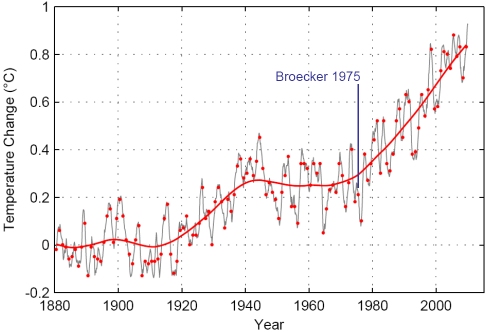
Global temperature up to June 2010 according to the NASA GISS data. Grey line is the 12-month running average, red dots are annual-mean values. The thick red line is a non-linear trend line. Broecker of course did not have these data available, not even up to 1975, since this global compilation was only put together in the late 1970s (Hansen et al. 1981). He had to rely on more limited meteorological data.
To those who even today claim that global warming is not predictable, the anniversary of Broecker’s paper is a reminder that global warming was actually predicted before it became evident in the global temperature records over a decade later (when Jim Hansen in 1988 famously stated that “global warming is here”).
Broecker is one of the great climatologists of the 20th Century: few would match his record of 400 scientific papers, a full sixty of which have over 100 citations each! Interestingly, his “global warming” paper is not amongst those highly-cited ones, with “only” 79 citations to date. Broecker is most famous for his extensive work on paleoclimate and ocean geochemistry.
It is very instructive to see how Broecker arrived at his predictions back in 1975 – not least because even today, many lay people incorrectly assume that we attribute global warming to CO2 basically because temperature and CO2 levels have both gone up and thus correlate. Broecker came to his prediction at a time when CO2 had been going up but temperatures had been going down for decades – but Broecker (like most other climate scientists at the time, and today) understood the basic physics of the issue.
Basically his prediction involved just three simple steps that in essence are still used today.
Step 1: Predict future emissions
Broecker simply assumed a growth in fossil fuel CO2 emissions of 3% per year from 1975 onwards. With that, he arrived at cumulative fossil CO2 emissions of 1.67 trillion tons by the year 2010 (see his Table 1). Not bad: the actual emissions turned out to be about 1.3 trillion tons (Canadell et al, PNAS 2007 – estimate extended to 2010 by me).
A shortcoming, from the modern point of view, is that Broecker did not include other anthropogenic greenhouse gases or aerosol particles in his calculations. He does however discuss aerosols, which he calls “dust”. In fact, the first sentence of the abstract (quoted above) in full starts with an if-statement:
If man-made dust is unimportant as a major cause of climate change, then a strong case can be made that the present cooling trend will, within a decade or so, give way to a pronounced warming induced by carbon dioxide.
That is a nod to the discussion about aerosol-induced cooling in the early 1970s. Broecker rightly writes:
It is difficult to determine the significance of the next most important climatic effect induced by man, “dust”, because of uncertainties with regard to the amount, the optical properties and the distribution of man-made particles,
citing a number of papers by Steve Schneider and others. Because he cannot quantify it, he leaves out this effect. Here luck was on Broecker’s side: the warming by other greenhouse gases and the cooling by aerosols largely cancel today, so considering only CO2 leads to almost the same radiative forcing as considering all anthropogenic effects on climate (see IPCC AR4, Fig. SPM.2).
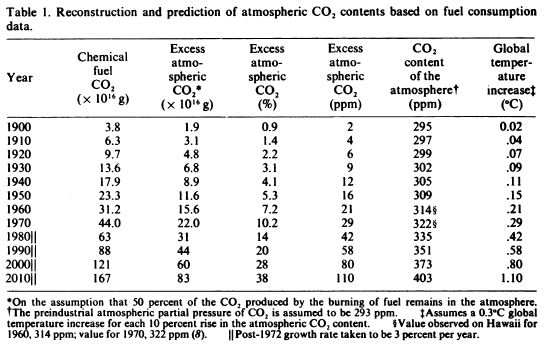
Table 1 of Broecker (1975)
Step 2: Predict future concentrations
To go from the amount of CO2 emitted to the actual increase in the atmosphere, one needs to know what fraction of the emissions remains in the air: the “airborne fraction”. Broecker simply assumed, based on past data of emissions and CO2 concentrations (Keeling’s Mauna Loa curve), that the airborne fraction is a constant 50%. I.e., about half of our fossil fuel emissions accumulates in the atmosphere. That is still a good assumption today, if you look at the observed CO2 increase as fraction of fossil fuel emissions. Broecker calculated that about 35% of the emissions is taken up by the ocean and the other 15% by the biosphere (again not far from modern values, see Canadell et al.). On this basis he argued that if the ocean is the main sink, the airborne fraction would remain almost constant for the decades to come (his calculations extend to the year 2010).
Thus, with a 3% increase in emissions per year and 50% of that remaining airborne, it is easy to compute the increase in CO2 concentrations. He obtains an increase from 295 to 403 ppm from 1900 to 2010. The actual value in 2010 is 390 ppm, a little lower than Broecker estimated because his forecast cumulative emissions were a little too high.
Step 3: Compute the global temperature response
Now we come to the temperature response to increased CO2 concentration. Broecker writes:
The response of the global temperature to the atmospheric CO2 content is not linear. As the CO2 content of the atmosphere rises, the absorption of infrared radiation will “saturate” over an ever greater portion of the band. Rasool and Schneider point out that the temperature increases as the logarithm of the atmospheric CO2 concentration.
Based on this logarithmic relationship (still valid today) Broecker assumes a climate sensitivity of 0.3ºC warming for each 10% increase in CO2 concentration, which amounts to 2.2ºC warming for CO2 doubling. This is based on early calculations by Manabe and Wetherald. Broecker writes:
Although surprises may yet be in store for us when larger computers and better knowledge of cloud physics allow the next stage of modeling to be accomplished, the magnitude of the CO2 effect has probably been pinned down to within a factor of 2 to 4.
The AR4 gives the uncertainty range of climate sensitivity as 2-4.5ºC warming for CO2 doubling, so there still is about a factor of 2 uncertainty and Broecker used a value near the very low end of this uncertainty range. Modern estimates are not only based on model calculations but also on paleoclimatic and modern data; the AR4 lists 13 studies that constrain climate sensitivity in its table 9.3.
In Broecker’s paper the warming calculated with the help of climate sensitivity happens instantaneously. Today we know that the climate system responds with a time lag due to ocean thermal inertia. By neglecting this, Broecker overestimated the warming at any given time; accounting for thermal inertia would have reduced his warming estimate by about a third (see AR4 Fig. SPM.5). But again he was lucky: picking ~2ºC rather than the more likely ~3ºC climate sensitivity compensates roughly for this, so his 20th-Century warming of 0.8ºC is almost spot on (the actual estimate being closer to 0.7ºC, see Fig. above). (A modern version of this back-of-envelope warming calculation is found e.g. in our book Our Threatened Oceans, p.82.)
Natural Variability
Broecker was not the first to predict CO2-induced warming. In 1965, an expert report to US President Lyndon B. Johnson had warned: “By the year 2000, the increase in carbon dioxide will be close to 25%. This may be sufficient to produce measurable and perhaps marked changes in climate.” And in 1972, a more specific prediction similar to Broecker’s was published by the eminent atmospheric scientist J.S. Sawyer in Nature (for a history in a nutshell, see my newspaper column here).
The innovation of Broecker’s article – apart from introducing the term “global warming” – was in combining estimates of CO2 warming with natural variability. His main thesis was that a natural climatic cooling
has, over the last three decades, more than compensated for the warming effect produced by the CO2 [....] The present natural cooling will, however, bottom out during the next decade or so. Once this happens, the CO2 effect will tend to become a significant factor and by the first decade of the next century we may experience global temperatures warmer than any in the last 1000 years.
The latter turned out to be correct. The idea that the small cooling from the 1940s to 1970s is due to natural variability still cannot be ruled out, although more likely this is a smaller part of the explanation and the cooling is primarily due to the “dust” neglected by Broecker, i.e. due to the rise of anthropogenic aerosol pollution (Taylor and Penner, 1994). However, the way Broecker estimated and even predicted natural variability has not stood the test of time. He used data from the Camp Century ice core in Greenland, arguing that these “may give a picture of the natural fluctuations in global temperature over the last 1000 years”. Ironically, Broecker’s own later work on Atlantic ocean circulation changes showed that Greenland is likely even less representative of global temperature changes than most other places on Earth, it being strongly affected by variability in ocean heat transport (see our recent post on the Younger Dryas, or Broecker’s latest book The Great Ocean Conveyor). However, Broecker was right to conclude that the buildup of CO2 would sooner or later overwhelm such natural climate variations.
Overall, Broecker’s paper (together with that of Sawyer) shows that valid predictions of global warming were published in the 1970s in the top journals Science and Nature, and warming has been proceeding almost exactly as predicted for at least 35 years now. Some important aspects were not understood back then, like the role of greenhouse gases other than CO2, of aerosol particles and of ocean heat storage. That the predictions were almost spot-on involved an element of luck, since the neglected processes do not all affect the result in the same direction but partly cancel. Nevertheless, the basic fact that rising CO2 would cause a “pronounced global warming”, as Broecker put it, was well understood in the 1970s. In a 1979 TV interview, Steve Schneider rightly described this as a consensus amongst experts, with controversy remaining about the exact magnitude and effects.
Reference
BROECKER WS, 1975: CLIMATIC CHANGE – ARE WE ON BRINK OF A PRONOUNCED GLOBAL WARMING?
SCIENCE Volume 189, Pages 460-463.
Monday, July 26, 2010
Nanotech Coating Produces Electricity From Sewage
http://www.dailytech.com/Nanotech+Coating+Produces+Electricity+From+Sewage/article19130.htm
Could change the face of wastewater treatment
Oregon State University engineers haveapplied new coatings on anodes of microbial electrochemical cells, which heightens their electricity production by 20 times, and is another step closer to producing electricity from sewage.
Could change the face of wastewater treatment
Oregon State University engineers haveapplied new coatings on anodes of microbial electrochemical cells, which heightens their electricity production by 20 times, and is another step closer to producing electricity from sewage.
The graphite anodes were coated with palladium at one point in order to produce electricity, but that didn't produce quite as much as the nanoparticle layer of gold, which is what increased the electricity production by about 20 times. This is a huge advance toward technology that could both produce levels of electricity and clean biowaste at the same time, ultimately changing the face ofrenewable energy and wastewater treatment. Also, this sort of technology could help treat wastewater in developing nations where an inadequate power supply prevents proper treatment.
During the course of these experiments, researchers inserted bacteria from sewage into an anode chamber and allowed it to form a biofilm, absorb nutrients and grow. The bacteria releases electrons during this process and fuels electricity production.
"This is an important step toward our goal," said Frank Chaplen, an associate professor of biological and ecological engineering. "We still need some improvements in design of the cathode chamber, and a better understanding of the interaction between different microbial species. But the new approach is clearly producing more electricity."
In addition, researchers have reason to believe that an iron nanoparticle coating would increase the electrical output of sewage as much as the layer of gold in some types of bacteria. Also, a "similar approach" could produce hydrogen gas rather than electricity, which could lead to further advancements in hydrogen fuel cell technology for cars as well as treating wastewater.
"Recent advances in nanofabrication provide a unique opportunity to develop efficient electrode materials due to the remarkable structural, electrical and chemical properties of nanomaterials," said the published research paper. "This study demonstrated that nano-decoration can greatly enhance the performance of microbial anodes."
While more research is required to lower costs and improve efficiency, researchers say this technology has been proven in the laboratory. The study was led by Hong Liu, an assistant professor of biological and ecological engineering, and was published in Biosensors and Bioelectronics.
Tuesday, June 22, 2010
Stanford Study Exposes Lack of Credibility and Expertise Among Climate Skeptics
A study by Stanford University researchers examining expert credibility in climate change has confirmed that climate skeptics and contrarians within the scientific community comprise at best 3% of the field, and are “vastly overshadowed” in expertise by their colleagues who agree that manmade climate change is real.
As readers of DeSmogBlog know well, the credibility of climate science and scientists has come under attack in recent months. In the wake of the Climategate episode –portrayed in the right wing media as a scandalous cover-up while independent investigations found no evidence calling into question the integrity of climate science – skeptics have loudly argued that the public shouldn’t trust the overwhelming consensus among scientists that man-made climate change is real.
Flipping that faulty assertion on its head, this new Stanford study, published today in the highly-regarded journal Proceedings of the National Academy of Sciences, provides even more reason for the public to scrutinize the credibility of the skeptics and contrarians themselves, showing them to possess less direct expertise and far fewer published works in the climate science literature than colleagues who agree with the consensus view.
Examining a group of 1,372 climate researchers, their publications and the number of times their work is cited by peers in related studies, the Stanford researchers found that:
1) 97-98% of the climate researchers most actively publishing in the field support the tenets of [man-made climate change] outlined by the Intergovernmental Panel on Climate Change; and 2) the relative climate expertise and scientific prominence of the researchers unconvinced of [man-made climate change] are substantially below that of the convinced researchers.”
The authors found that:
“the expertise and prominence, two integral components of overall expert credibility, of climate researchers convinced by the evidence of [anthropogenic climate change] vastly overshadows that of the climate change skeptics and contrarians.”
Reviews of the scientific literature and surveys of climate scientists “indicate striking agreement with the primary conclusions of the Intergovernmental Panel on Climate Change (IPCC),” according to the study.
But you would hardly know that from watching Fox News or reading mainstream media coverage of climate change lately.
Using Climategate and the juvenile theatrics of a handful of Republican politicians as fuel, climate deniers have waged a fierce media campaign to confuse the public in recent months, an effort that poll results in the U.S. indicate had a negative impact on public understanding of climate change and recognition of the urgent need to address it.
While skeptics have been given plenty of oxygen on talk radio and TV lately, they remain remarkably quiet in the annals of peer-reviewed literature. Reams of data and papers have been published in the best scientific journals documenting and supporting the consensus view that humans have altered the climate in potentially catastrophic ways.
In contrast, evidence to support the views of contrarians and skeptics remains mostly unrecognized and unpublished in scientific journals. That is not an indication that the peer-review process is somehow corrupt, as some skeptics contend, but rather a clear sign that skeptics have failed to present to their peers any credible evidence to support their contrary opinions.
It is interesting to note that the study, which was funded by the William and Flora Hewlett Foundation and Stanford University, did not look at the issue of industry funding or conflicts of interest among the skeptics identified in the report. Even without taking those important factors into account, the Stanford researchers demonstrate a clear lack of credibility among skeptics who doubt man-made climate change. The vast majority of skeptics who signed onto joint statements denying man-made climate change “have not published extensively in the peer-reviewed climate literature,” the study found.
This study from Stanford has documented yet again the total lack of credibility and expertise among climate skeptics, yet as long as Fox News and talk radio exist, the public will continue to be duped into the false assumption that there is doubt among the scientific community on this issue.
While President Obama has pledged to craft policy based on the best science available and to consult with the most credible experts, climate skeptics have used biased media outlets and a bullhorn to sow doubt about the scientific consensus on climate change. That dangerous distraction enables lawmakers to avoid making science-based policy decisions, delaying action on climate change and fostering continued dependence on dirty energy sources.
Thursday, June 17, 2010
Joe Public v the volcano - Slavoj Zizek
We are living in an age when we are both able to change nature and more at its mercy than ever –– as the Icelandic volcano has proved.

Many of those who have a fear of flying are haunted by a particular thought: that is, how many parts of such a complicated machine as a modern plane have to function smoothly in order for it to stay in the air? One small lever breaks somewhere, and the plane may spiral downwards . . . When you start to think how many things could go wrong, you cannot help but panic.
The people of Europe have experienced something similar in the past few weeks. That a cloud from a minor volcanic eruption in Iceland - a small disturbance in the complex mechanism of life on earth - can bring to a standstill the air traffic over almost an entire continent is a reminder of how humankind, for all its power to transform nature, remains just another living species on the planet.
The serious socio-economic impact of such a minor outburst is a result of our technological development (in this case, air travel); a century ago, such an eruption would have passed almost unnoticed. Technological development has made us more independent from nature and, at the same time, on a different level, more dependent on nature's whims. Decades ago, when a man first stepped on the surface of the moon, his now-legendary words were "That's one small step for [a] man; one giant leap for mankind". With the eruption in Iceland, it was more "a small step back for nature, but a giant step back for humankind".
Our growing freedom from and control over nature - indeed our survival - rely on a series of stable natural parameters that we tend to take for granted: in temperature, for example, the composition of the air, water and energy supply, and so on. We can "do what we want" only so long as we remain marginal enough. The limits to our freedom become palpable with ecological disturbances, as our ability to transform nature destabilises the basic geological conditions of life on earth.
That humankind is becoming a geological agent on earth indicates the beginning of a geological era that some scientists have named the "Anthropocene": the time of man. Certainly, there are good reasons to surmise that the main cause of the unexpected strength of the devastating earthquake in China in 2008 (if not the earthquake itself) was the construction of the enormous Zipingpu Dam in the region. This created large new artificial reservoirs, and the additional pressure on the surface seems to have influenced the balance of the underground cliffs, thus contributing to the earthquake.
There is, however, something deceptively reassuring in this readiness to assume responsibility for the threats to our environment. We like to feel guilty because that suggests everything depends on us - if we pull the strings of the catastrophe, then we can save ourselves simply by changing our lives. The ongoing volcanic outburst is a reminder that our ecological troubles cannot be reduced to our hubris, to our disturbing the balanced order of earth.
Nature is chaotic and prone to wild, unpredictable and meaningless disasters, and we are exposed to its merciless whims - there is no Mother Earth watching over us. Indeed, in the case of a volcano, the danger comes from inside the bowels of the earth; from beneath our feet, not from outer space. We have nowhere to withdraw.
Science is helpless
In the media, the volcanic ash has sometimes been treated as a natural catastrophe, sometimes as a meteorological phenomenon; sometimes it has been said to concern the economy (that is, the financial loss of the airline companies or of those who rely on air transport, such as the flower growers in Kenya). At other times the focus has been on the disruption of social life and the plight of passengers stranded abroad for days, even weeks. The main argument in favour of the closure of airspace over Europe was the danger that the volcanic dust posed to planes' engines; the main argument against was the financial loss this closure entailed for the airlines and the wider economy.
The confusion of natural and cultural or economic concerns in the arguments over the prohibition of flights raised the following suspicion: how come the scientific evidence began to suggest it was safe to fly over most of Europe just when the pressure from the airlines became most intense? Is this not further proof that capital is the only real thing in our lives, with even scientific judgements having to bend to its will?
The problem is that scientists are supposed to know, but they do not. Science is helpless and covers up this helplessness with a deceptive screen of expert assurance. We rely more and more on experts, even in the most intimate domains of our experience (sexuality and religion). As a result, the field of scientific knowledge is transformed into a terrain of conflicting "expert opinions".
Most of the threats we face today are not external (or "natural"), but generated by human activity shaped by science (the ecological consequences of our industry, say, or the psychic consequences of uncontrolled genetic engineering), so that the sciences are simultaneously the source of such threats, our best hope of understanding those threats, and the means through which we may find a way of coping with them.
Even if we blame scientific-technological civilisation for global warming, we need the same science not only to define the scope of the threat, but also, often, to perceive it in the first place. The "ozone hole", for example, can be "seen" in the sky only by scientists. That line from Wagner's Parsifal - "Die Wunde schliest der Speer nur, der Sie schlug" ("The wound can only be healed by the spear that made it") - acquires a new relevance here.
How much can we "safely" pollute our environment? How many fossil fuels can we burn? How much of a poisonous substance does not threaten our health? That our knowledge has limitations does not mean we shouldn't exaggerate the ecological threat. On the contrary, we should be even more careful about it, given that the situation is extremely unpredictable. The recent uncertainties about global warming signal not that things are not too serious, but that they are even more chaotic than we thought, and that natural and social factors are inextricably linked.
Either we take the threat of ecological catastrophe seriously and decide today to do things that, if the catastrophe does not occur, will
appear ridiculous, or we do nothing and risk losing everything if the catastrophe does take place. The worst response would be to apply
a limited range of measures - in that case, we will fail whatever happens.
Unknown knowns
When it comes to the risk of ecological catastrophe, we are dealing with "unknown unknowns", to use the terms of the Rumsfeldian theory of knowledge. Donald Rumsfeld set out this theory in a bit of amateur philosophising in February 2002, when he was still George W Bush's defence secretary. He said:
There are known knowns; there are things we know we know. We also know there are known unknowns; that is to say we know there are some things we do not know. But there are also unknown unknowns - the ones we don't know we don't know.
What Rumsfeld forgot to add was the crucial fourth term: the "unknown knowns", things we don't know that we know - which is the Freudian unconscious, the "knowledge which doesn't know itself", as Lacan put it. To the assertion that the main dangers in the Iraq war were the "unknown unknowns" - the threats that we did not even suspect existed - we should reply that the main dangers are, on the contrary, the "unknown knowns", the disavowed beliefs and suppositions to which we are not even aware we adhere.
In the case of ecology, these disavowed beliefs and suppositions are the ones that prevent people from believing in the possibility of catastrophe, and they combine with the "unknown unknowns".
Humankind should get ready to live in a more nomadic way: local or global changes in environment may demand unprecedented large-scale social transformations. Let's say that a huge volcanic eruption makes the whole of Iceland uninhabitable: where will the people of Iceland move? Under what conditions? Should they be given a piece of land, or just dispersed around the world? What if northern Siberia becomes more inhabitable and appropriate for agriculture, while great swaths of sub-Saharan Africa become too dry for a large population to live there - how will the exchange of population be organised? When similar things happened in the past, the social changes occurred in a wild, spontaneous way, with violence and destruction. Such a prospect is catastrophic in a world in which many nations have access to weapons of mass destruction.
One thing is clear: national sovereignty will have to be redefined and new levels of global co-operation invented. And what about the immense changes to economies and consumption levels demanded and brought about by new weather patterns or shortages of water and energy sources? How will such changes be decided and executed?
It is instructive, here, to return to the four elements of what the French Marxist philosopher Alain Badiou calls the "eternal idea" of revolutionary politics. What is demanded, first, is strict egalitarian justice: worldwide norms of per capita energy consumption should be imposed, stopping developed nations from poisoning the environment at the present rate while blaming developing countries, from Brazil to China, for ruining our shared environment.
Terror firmer
Second, terror: the ruthless punishment of all those who violate the imposed protective measures, including severe limitations of liberal "freedoms" and the technological control of prospective lawbreakers. Third, voluntarism: the only way to confront the threat of ecological catastrophe is by means of collective decision-making that will arrest the "spontaneous" logic of capitalist development (Walter Benjamin, in his essay "On the Concept of History", pointed out that the task of a revolution is to "stop the train" of history that runs towards the precipice of global catastrophe - an insight that has gained new weight with the prospect of ecological catastrophe).
Last but not least, trust in the people: the wager that the large majority of the people support these severe measures, see them as their own and are ready to participate in their enforcement. We should not be afraid to encourage, as a combination of terror and trust in the people, the resurgence of an important figure in all egalitarian-revolutionary terror - the "informer" who denounces culprits to the authorities. (In the case of the Enron scandal, Time magazine was right to celebrate the insiders who tipped off the financial authorities as true public heroes.)
Once upon a time, we called this communism.
Subscribe to:
Posts (Atom)
